
Key Insights at a Glance
A small number of countries dominate both the remaining area and the loss of the world’s humid tropical primary forests. Brazil alone holds roughly one third of all remaining humid tropical primary forest, yet it also accounts for more than a quarter of total tree cover loss since 2002. Together, the top five countries Brazil, Democratic Republic of the Congo, Indonesia, Peru, and Colombia contain about 65 percent of the world’s humid tropical primary forest and contribute around 60 percent of total loss.
There is a clear and troubling pattern. Countries with the largest forest areas experience the greatest absolute deforestation, while countries with smaller forest areas often suffer the highest percentage loss. This means some countries are quietly losing a very large share of their primary forests without attracting global attention.
Another major finding is the presence of synchronized spikes in deforestation around 2016, 2017, and again in 2024 across many countries. This suggests global or regional drivers rather than isolated national events. While Indonesia shows a notable reversal after 2016, most other countries continue on an upward trend of forest loss.
This article explores these patterns in detail using data from Global Forest Watch and the World Resources Institute, focusing specifically on humid tropical primary forests across 76 countries.
About the Data and Definitions
This analysis is based on deforestation data from Global Forest Watch, developed by the World Resources Institute. The dataset covers tree cover loss from 2002 to 2024 and uses a baseline measurement from the year 2001.
Tree cover loss is derived from satellite imagery and is defined as stand replacement disturbance. In practical terms, this means the clearing of at least half of the tree cover within a 30 meter by 30 meter pixel. Global Forest Watch applies a canopy cover threshold of more than 30 percent for its statistics. Throughout this article, tree cover loss is interpreted as deforestation.
The focus here is a specific subset of the data: humid tropical primary forests. These forests are particularly important because they store large amounts of carbon, support high biodiversity, and play a crucial role in climate regulation.
Where the World’s Humid Tropical Primary Forests Are Located
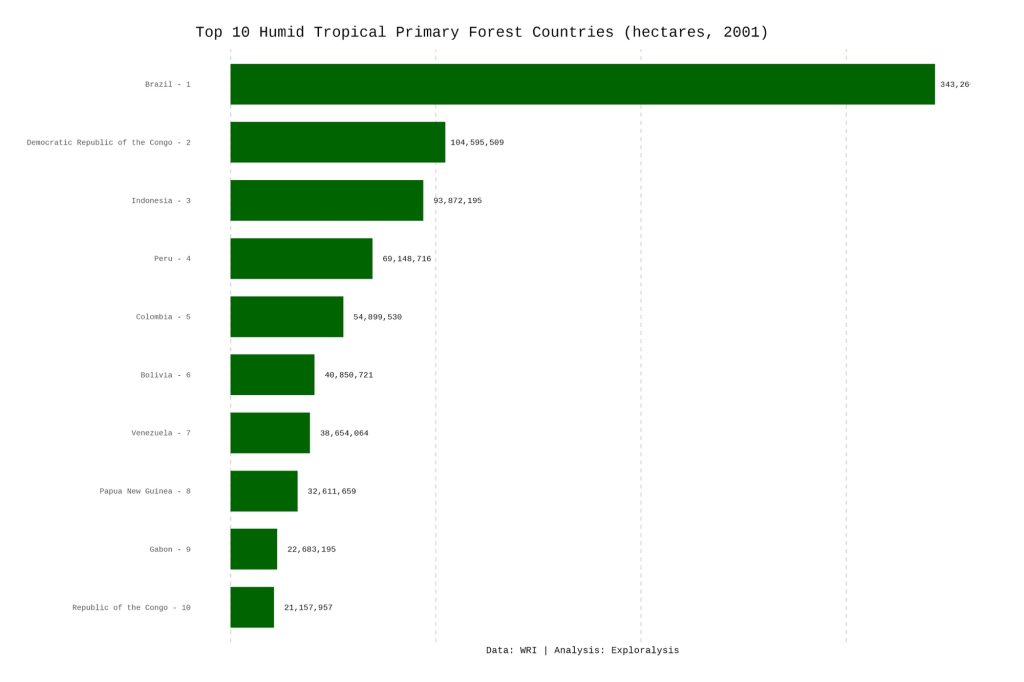
Based on the 2001 baseline data, humid tropical primary forests are highly concentrated in a small number of countries. The top countries by forest area are Brazil, Democratic Republic of the Congo, Indonesia, Peru, Colombia, Bolivia, Venezuela, Papua New Guinea, Gabon, and the Republic of the Congo.
Brazil stands far above all others, with more than 343 million hectares of humid tropical primary forest at baseline. The Democratic Republic of the Congo comes second with about 104 million hectares, roughly one third of Brazil’s total.
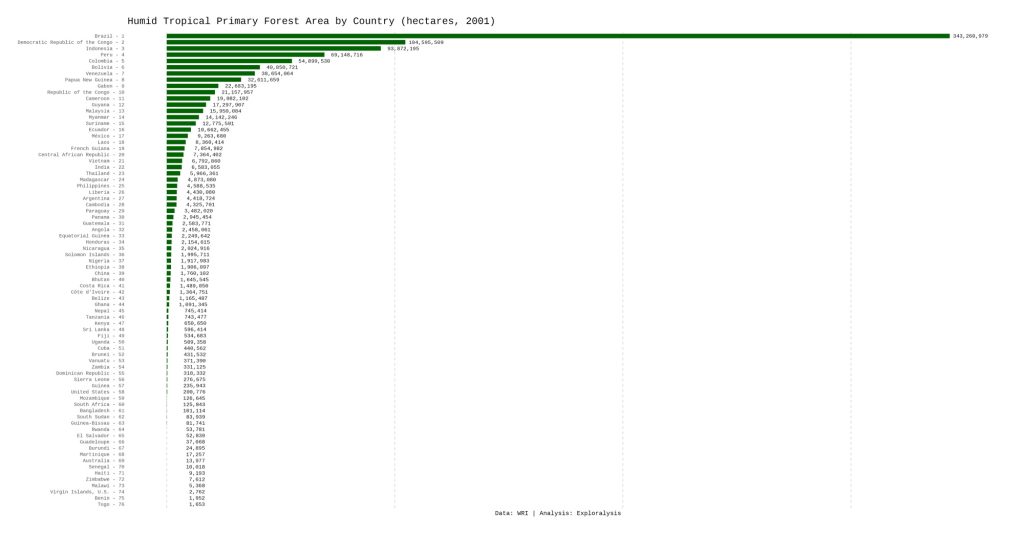
In global terms, Brazil alone accounts for approximately 33 percent of all humid tropical primary forest. The top five countries together hold around 65 percent of the world’s remaining humid tropical primary forests. This concentration makes conservation efforts in these countries especially critical, as outcomes there largely determine global trends.
Total Tree Cover Loss from 2002 to 2024
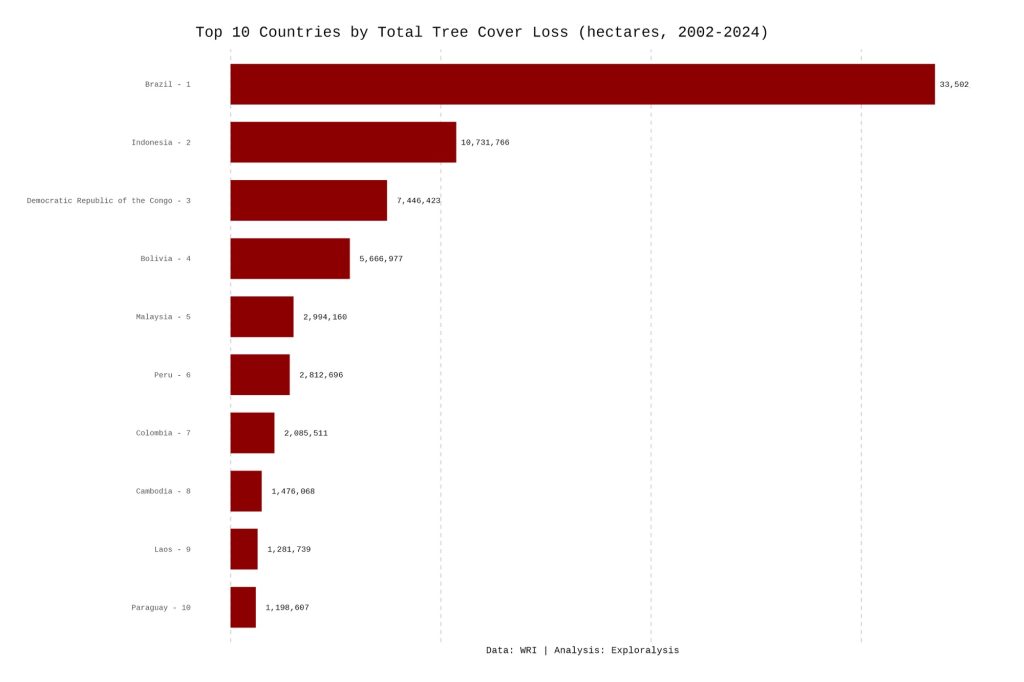
When looking at cumulative tree cover loss over the 22 year period, Brazil again stands out. The country lost approximately 33 million hectares of humid tropical primary forest between 2002 and 2024. This is far more than any other country in the dataset.
Indonesia ranks second in total loss, with about 10 million hectares lost during the same period. This is roughly one third of Brazil’s loss. On average, across all 76 countries, a country lost about 1 million hectares over the observation period.

Brazil alone contributes around 28 percent of total global humid tropical primary forest loss. When combined, the top five countries account for approximately 60 percent of total loss. These figures reinforce the idea that deforestation is heavily concentrated geographically.
Percentage Loss Tells a Different Story

Absolute loss highlights the impact of large countries, but percentage loss reveals a different and equally important dimension. Some countries have lost a very large share of their original humid tropical primary forest, even if their total area is smaller.
Nicaragua has experienced the highest percentage loss, at around 37 percent. Other countries with severe percentage losses include Paraguay, Cambodia, Haiti, and Cote d’Ivoire. On average, countries in the dataset lost about 9 percent of their humid tropical primary forest between 2002 and 2024.
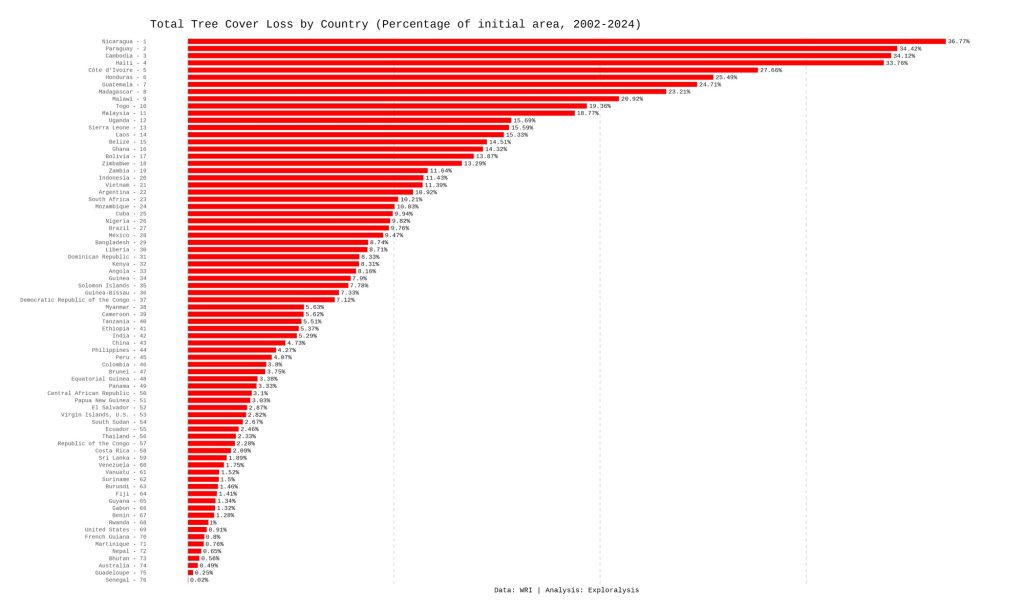
This distinction matters. Countries with smaller forest areas can lose ecological functions, biodiversity, and climate resilience much faster, even if their losses appear small in global totals.
Average Annual Loss: Absolute Area Versus Percentage

Looking at annual averages helps smooth year to year volatility and reveal long term patterns.
In absolute terms, Brazil has the highest average annual tree cover loss, at approximately 1.5 million hectares per year. Indonesia follows with around 467 thousand hectares per year.
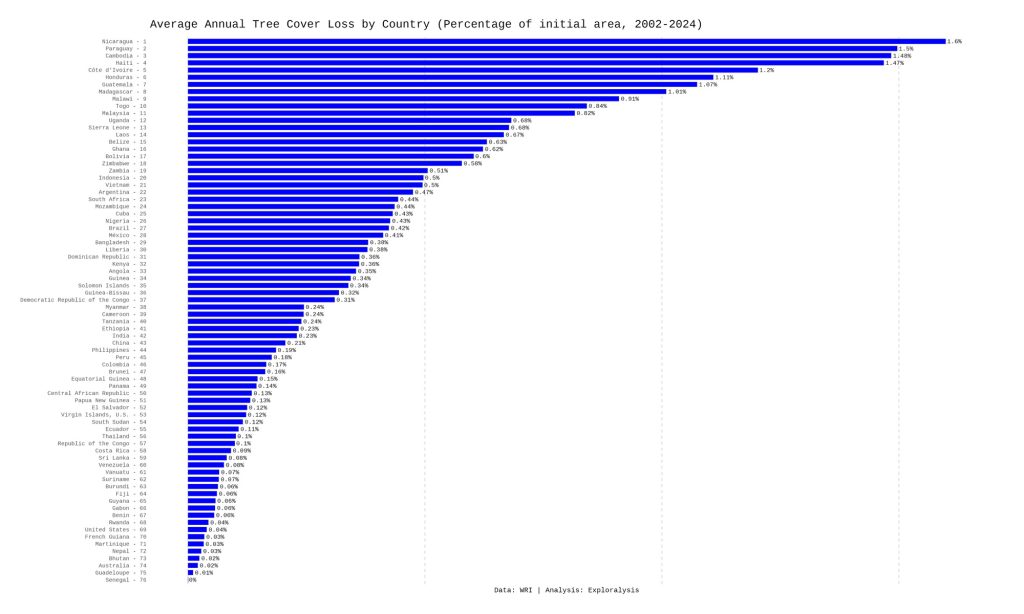
In percentage terms, Nicaragua and Paraguay lead, losing about 1.6 percent and 1.5 percent of their humid tropical primary forest per year, respectively. Notably, the countries with the highest annual percentage loss are the same ones that show the highest total percentage loss over the full period. This consistency suggests long term structural drivers rather than short term shocks.
The top four countries by percentage loss Nicaragua, Paraguay, Cambodia, and Haiti have each lost more than 30 percent of their humid tropical primary forest since 2002.
Global Spikes in Deforestation Activity

When examining annual tree cover loss percentages across all countries, several years stand out. Many countries show sharp spikes around 2016, 2017, and again in 2024.
The fact that these spikes appear across multiple regions suggests broader forces at work. Possible explanations include global commodity price cycles, policy shifts, climate anomalies such as El Nino, or changes in enforcement and governance. These years warrant deeper investigation to understand the drivers behind the sudden increases.
Comparing the Largest Forest Countries Over Time
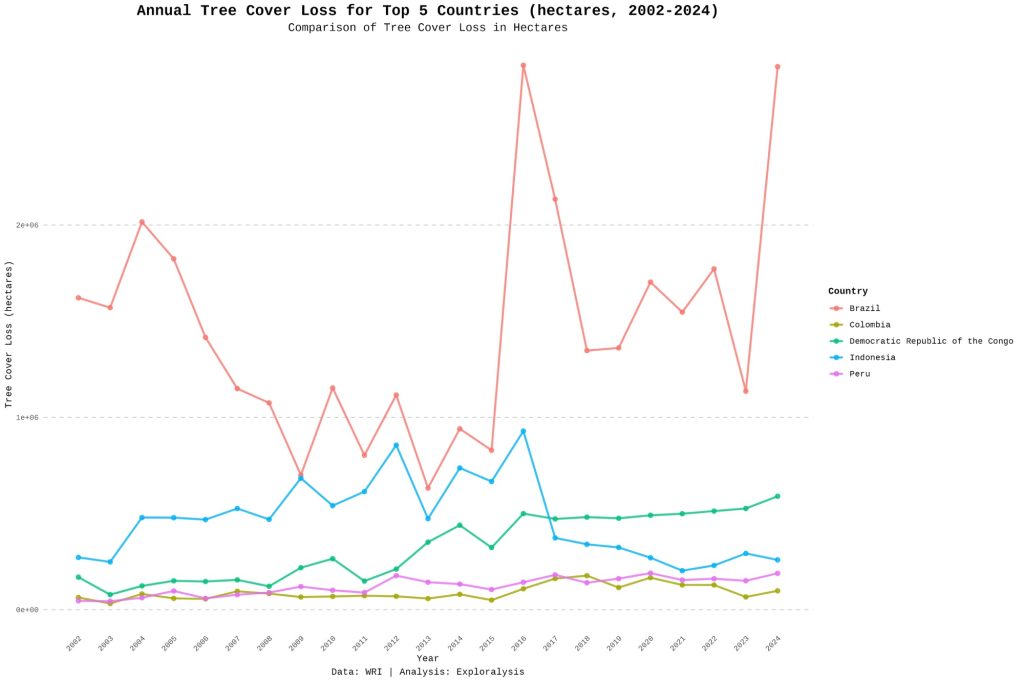
Focusing on the top five countries by baseline forest area provides further insights.
In absolute terms, Brazil consistently dominates annual tree cover loss, reflecting its vast forest area. Colombia remains at the lower end among the top five, consistent with its smaller baseline area.
Indonesia presents an interesting case. Although it ranks third in baseline forest area, it was second in absolute loss until around 2017. After that point, it moved to third place, aligning more closely with its proportional share. This suggests that Indonesia experienced disproportionately high deforestation relative to its forest area before 2017, followed by a period of improvement.
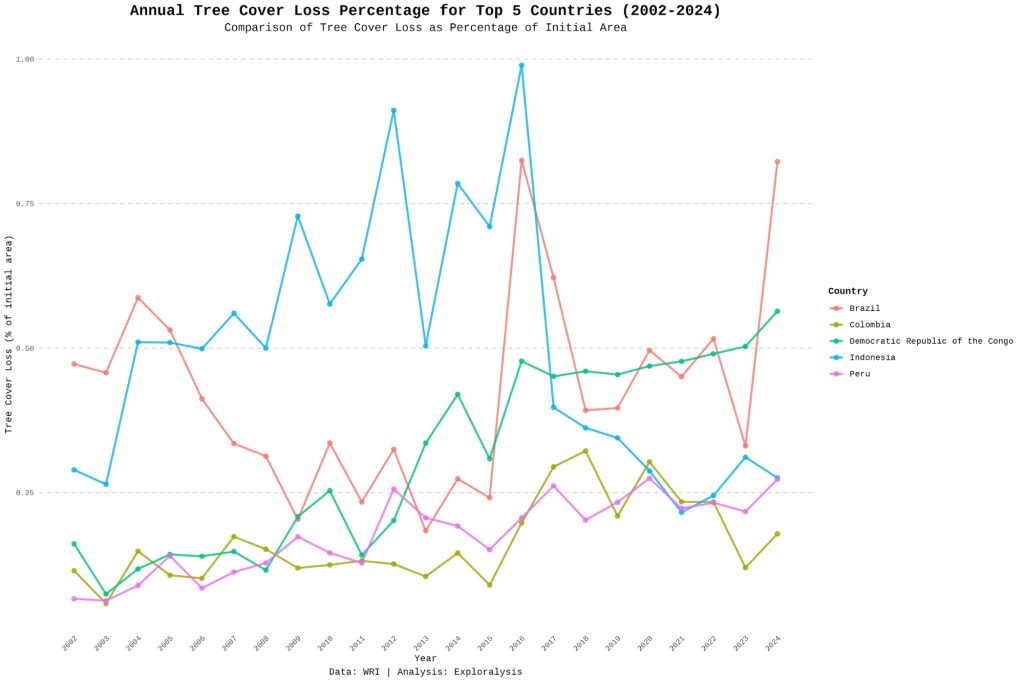
In percentage terms, Brazil, Indonesia, and the Democratic Republic of the Congo stand out. These countries are not only large in absolute terms but also experience relatively high proportional losses compared to other large forest countries.
Country Level Trends in the Top 10
Brazil
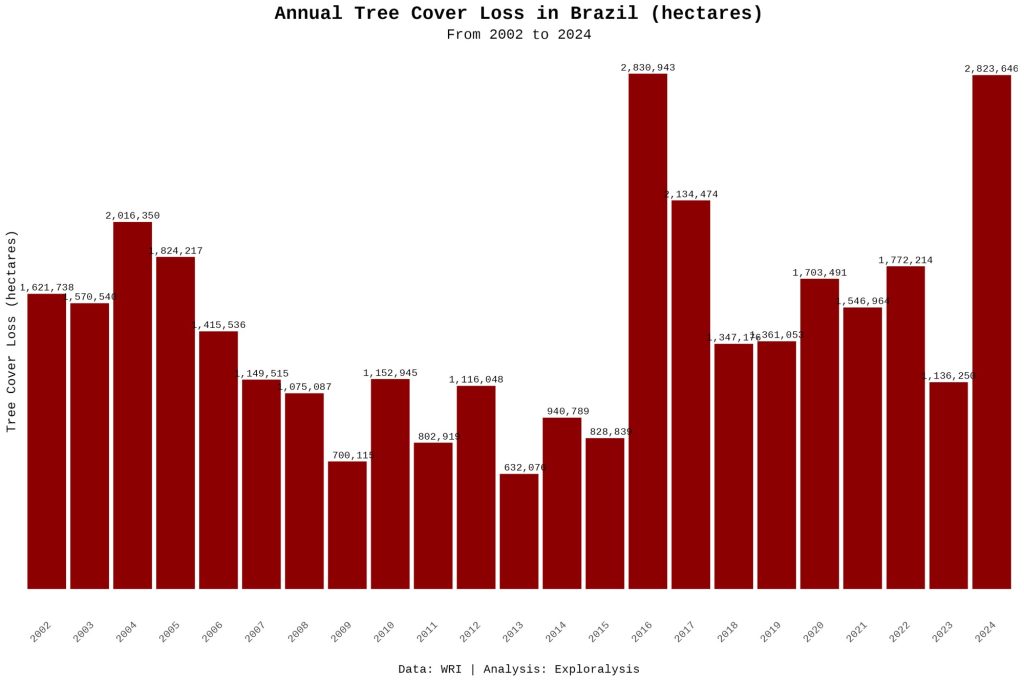
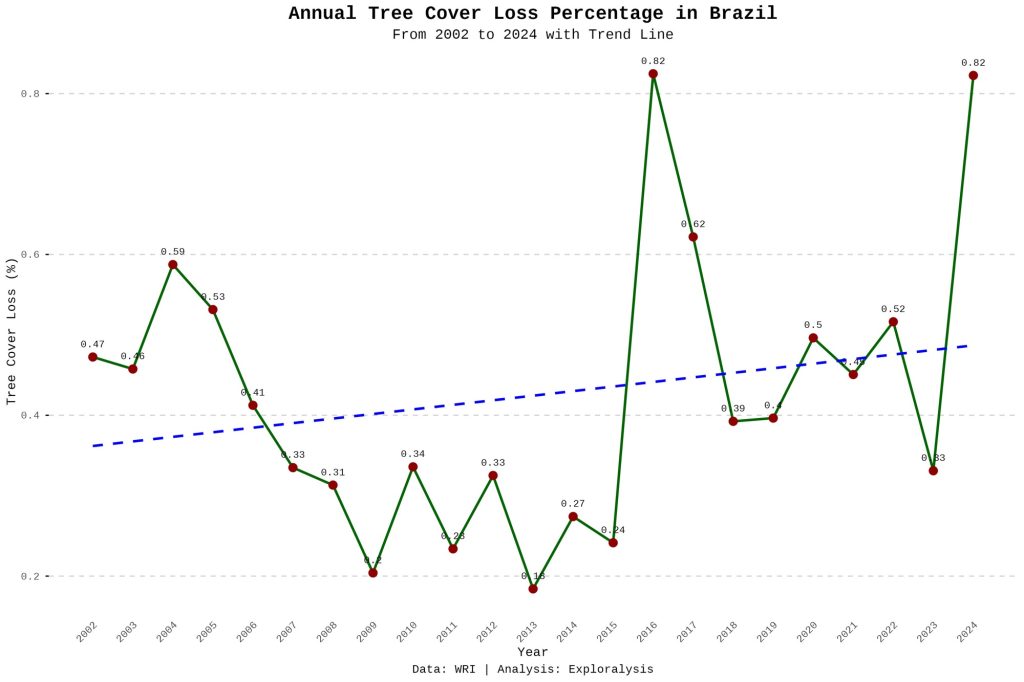
Brazil’s deforestation trend shows a slow overall increase with notable spikes in 2004, 2016, and 2024. There is a clear dip between 2007 and 2015, suggesting a period of stronger control or policy effectiveness. After 2017, average annual deforestation rises again, with 2016 and 2024 resembling years of sudden loss.
Democratic Republic of the Congo
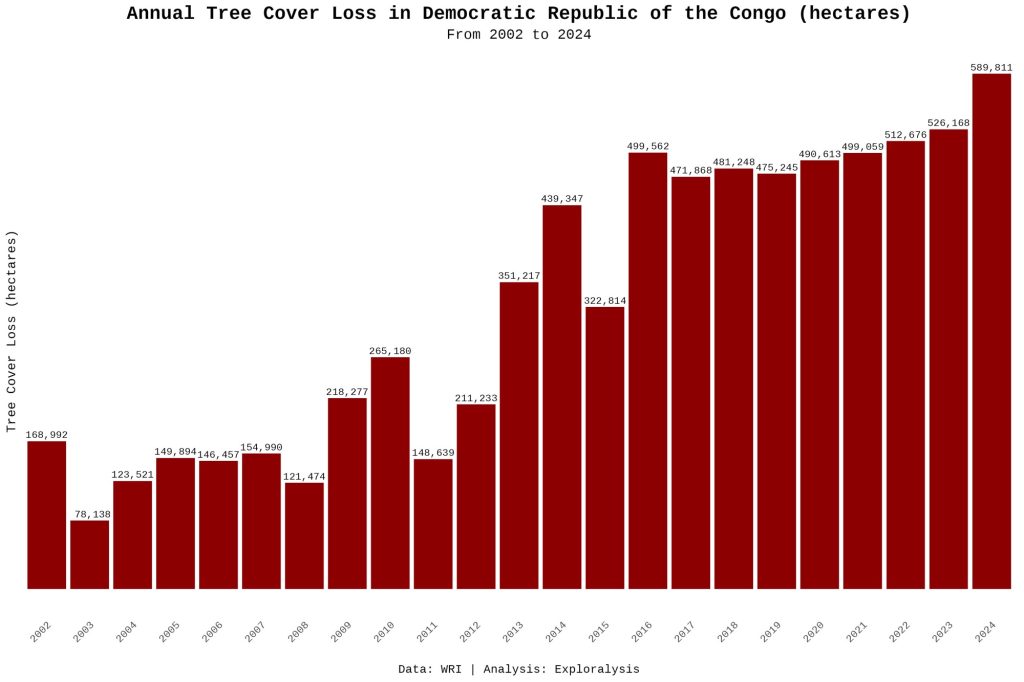
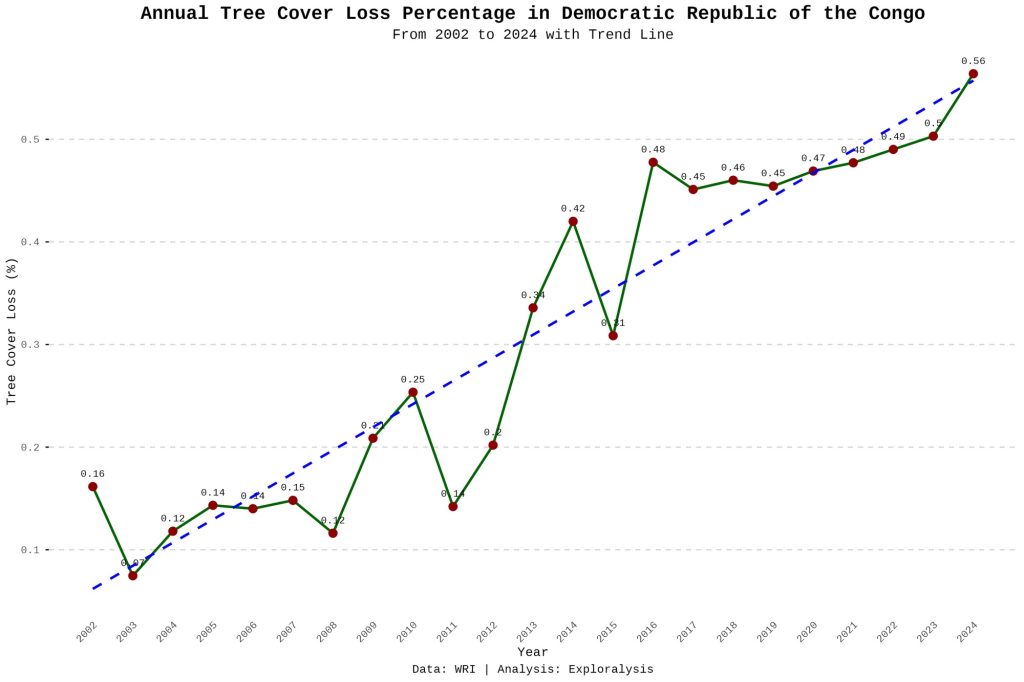
The Democratic Republic of the Congo shows a steep and consistent increase from 2003 to 2024. There are brief slowdowns around 2008 and 2011 to 2012, but the overall trajectory remains upward.
Indonesia
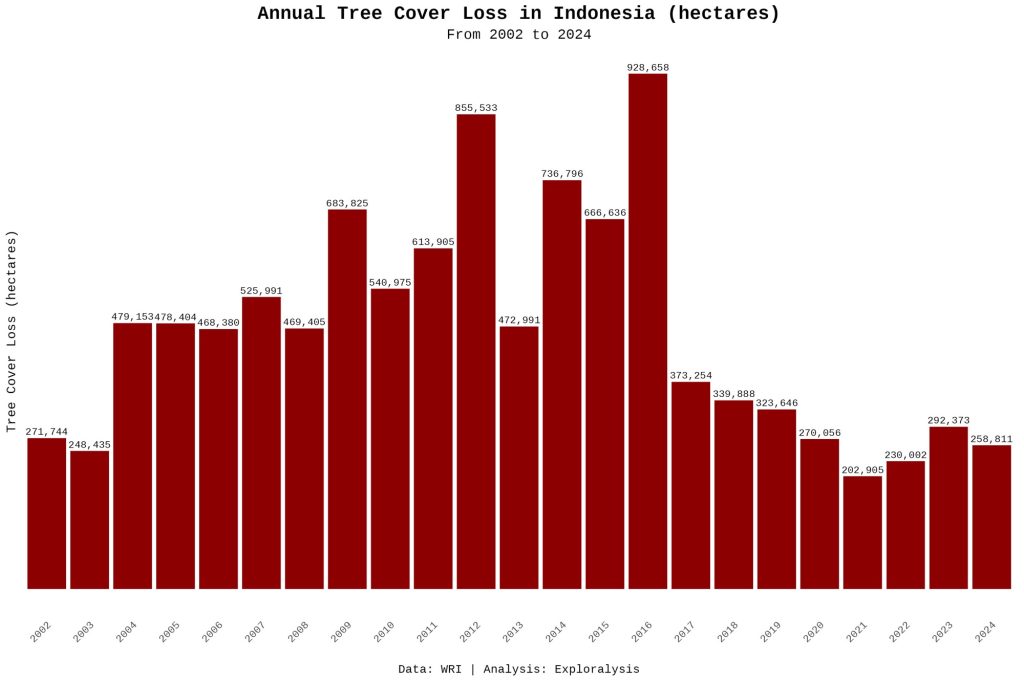
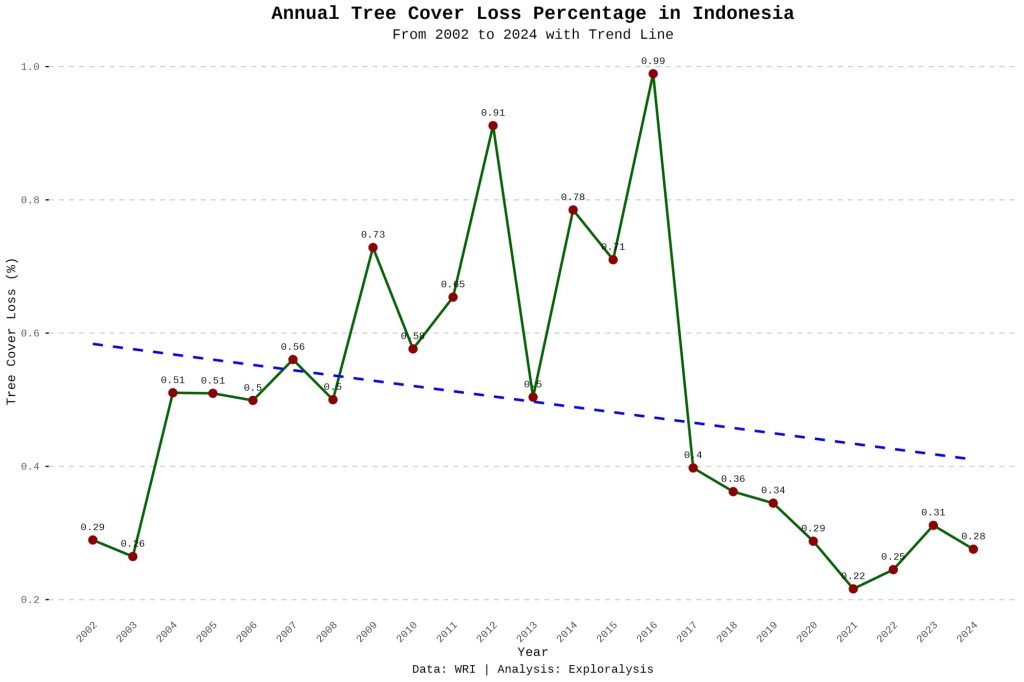
Indonesia’s trend rises sharply from 2003 to 2016, followed by an abrupt decline. After 2016, deforestation continues to fall gradually through 2024. This reversal sets Indonesia apart from most other top forest countries.
Peru
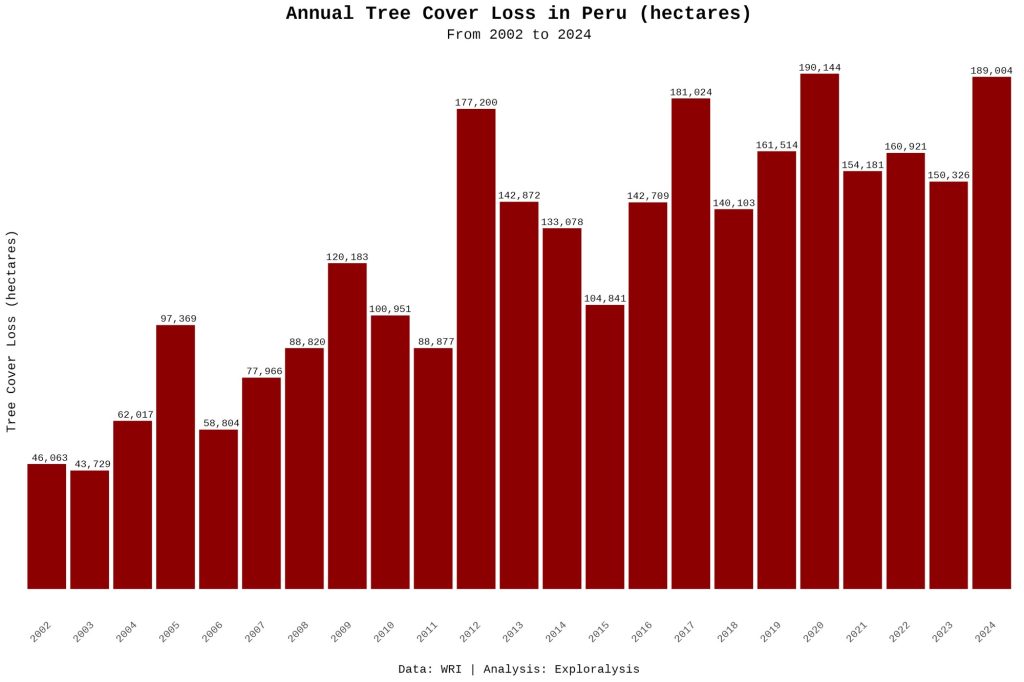
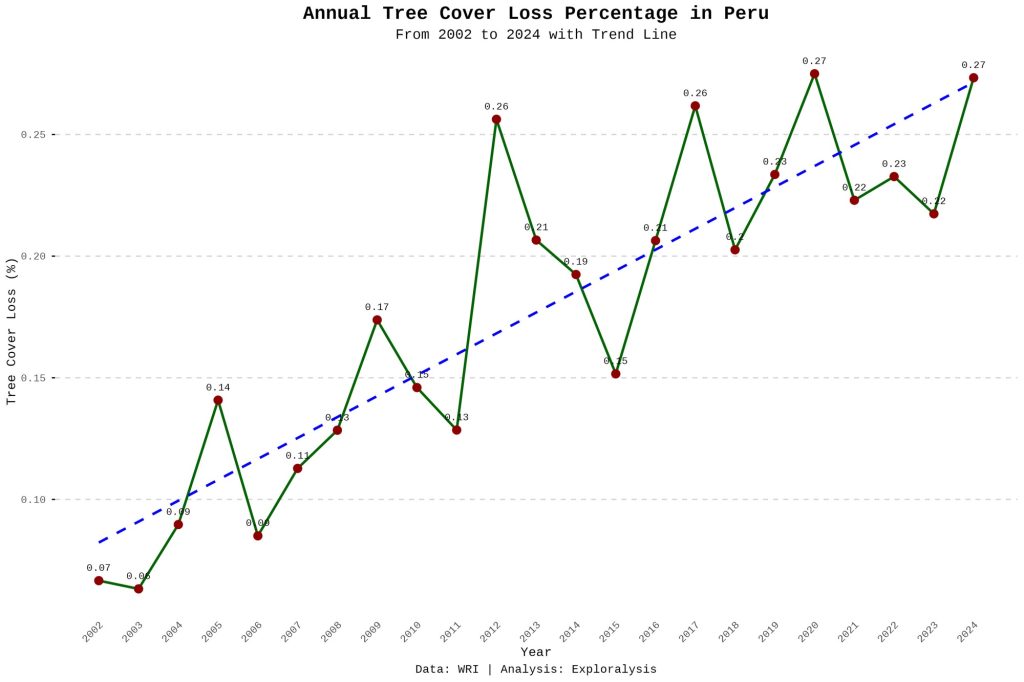
Peru exhibits a steady upward trend from 2002 to 2024, with alternating dips and spikes every few years. Despite short term fluctuations, the long term direction remains upward.
Colombia
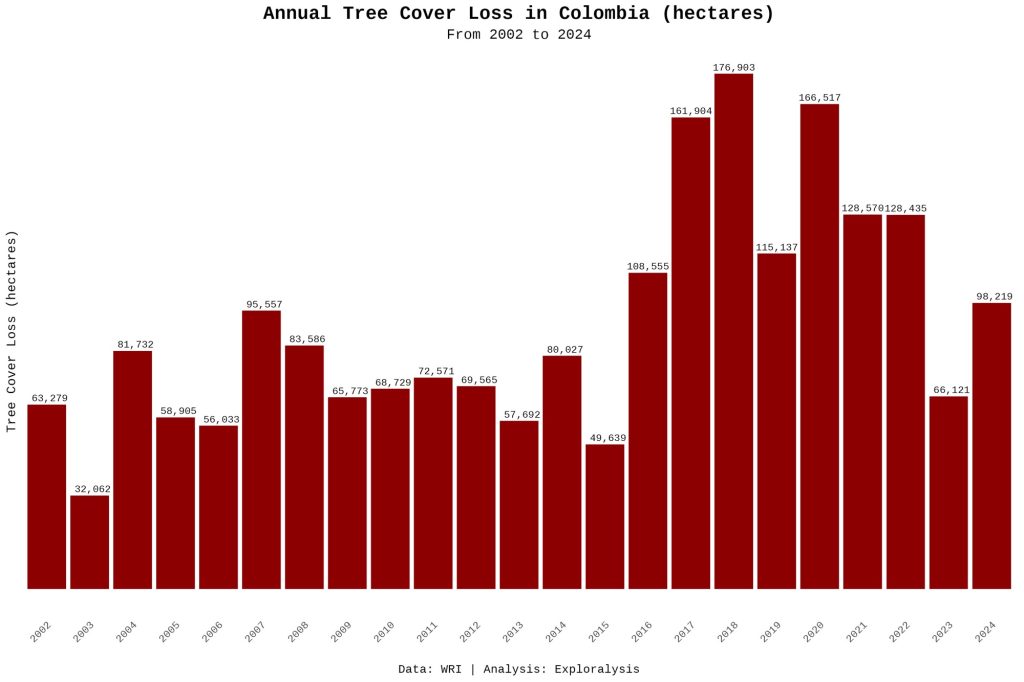
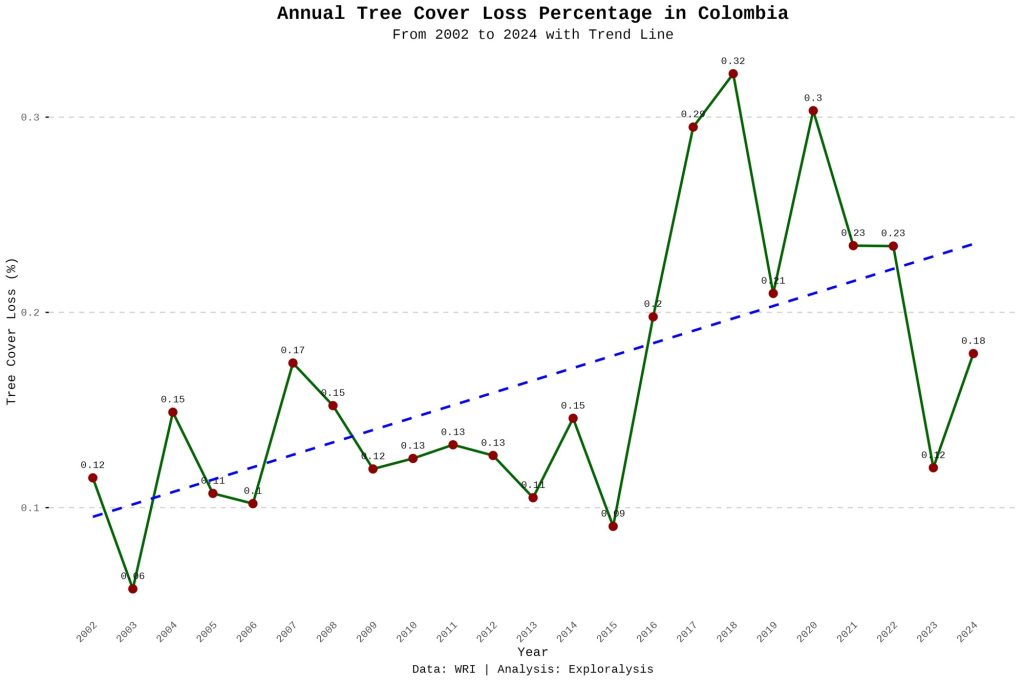
Colombia shows a slow increase from 2002 to 2015, followed by a pronounced surge between 2016 and 2022. After that, deforestation declines sharply.
Bolivia
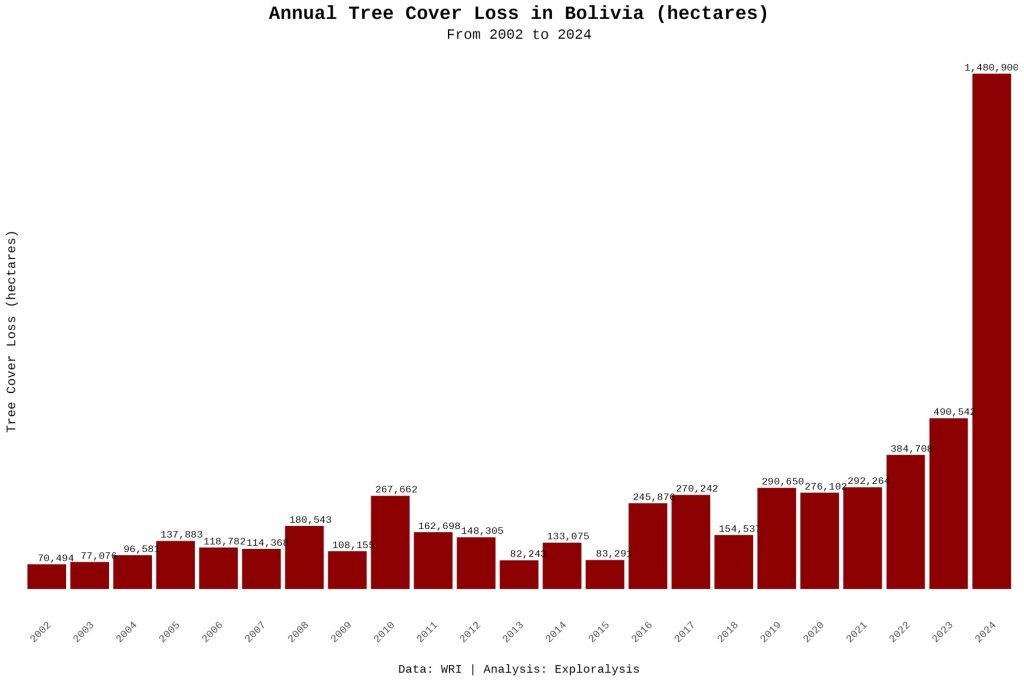
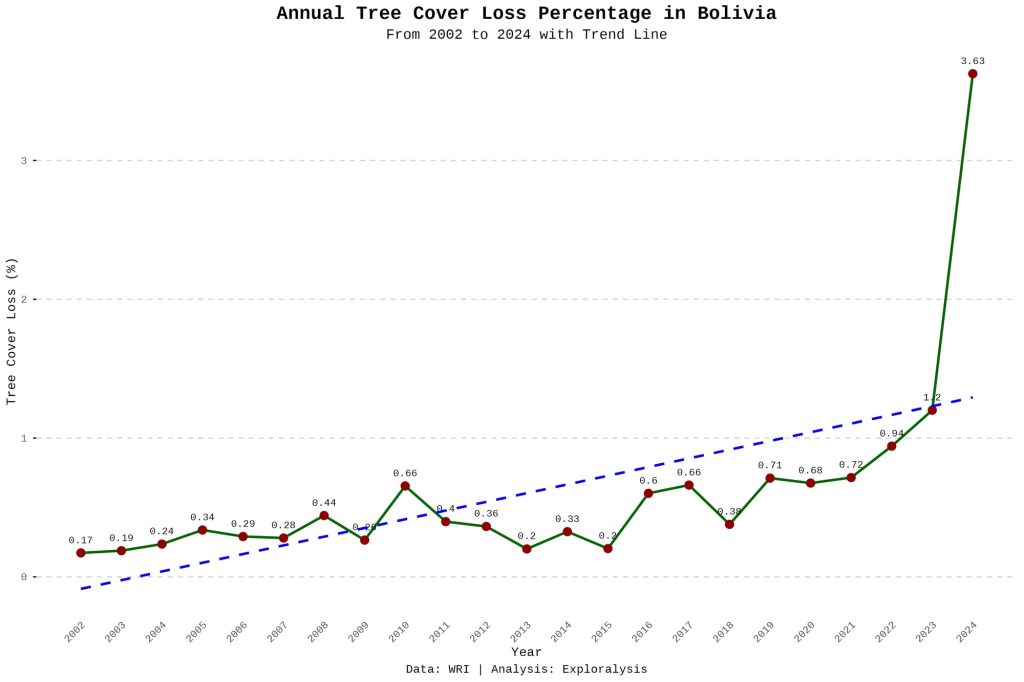
Bolivia’s trend rises slowly until 2023, followed by a sudden spike in 2024, indicating a recent acceleration in forest loss.
Venezuela
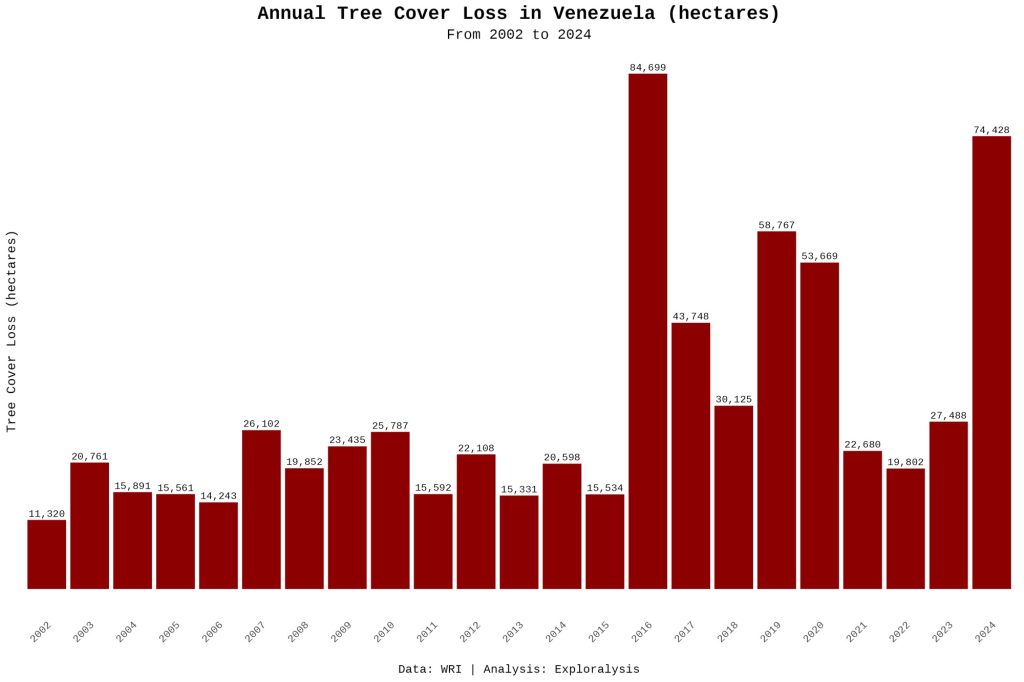
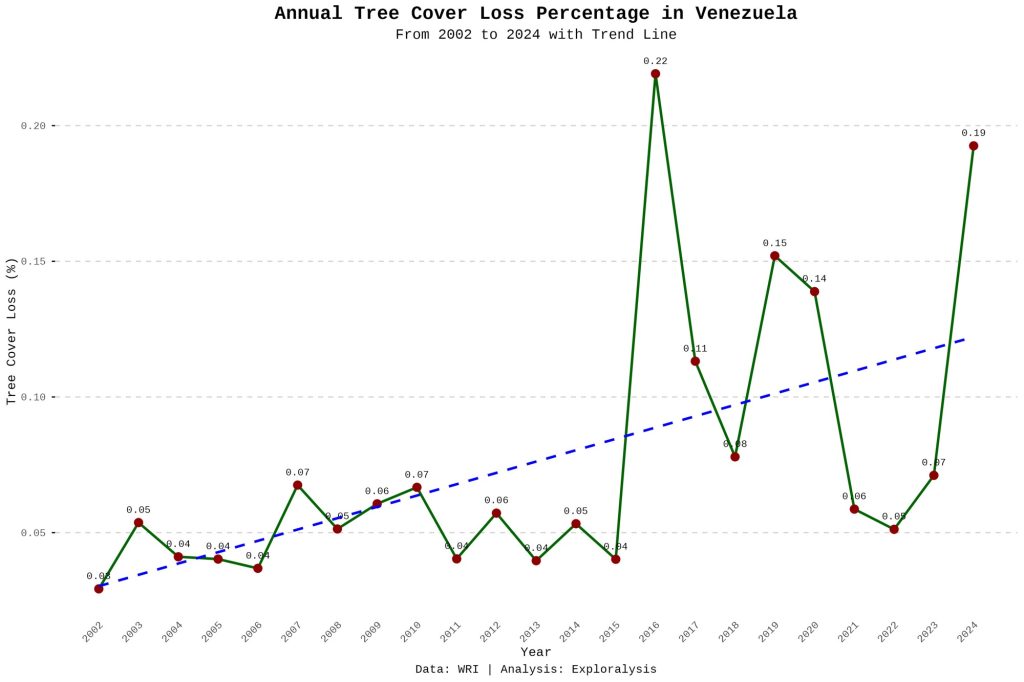
Venezuela remains relatively stable until 2015, after which it experiences multiple abrupt spikes. There is a noticeable dip between 2021 and 2023, but overall volatility increases after 2015.
Papua New Guinea
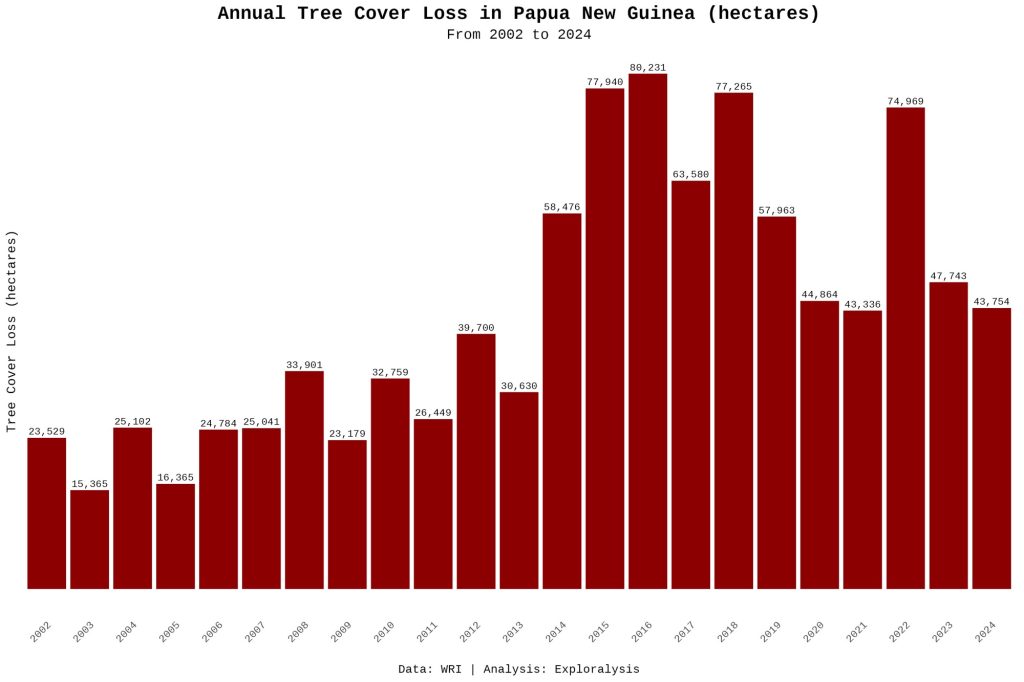
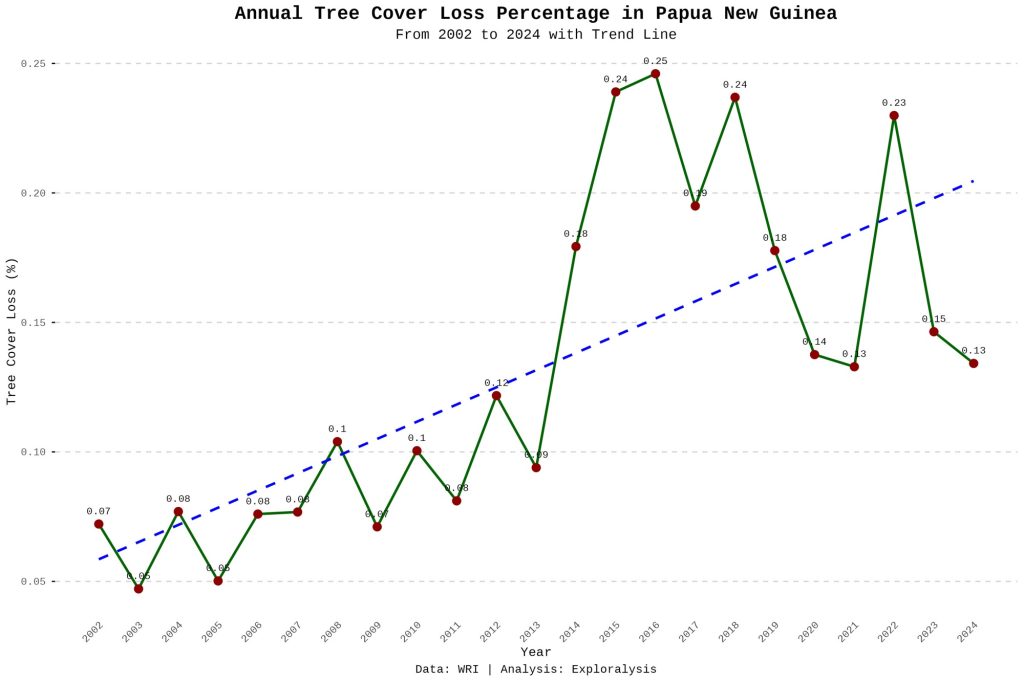
Papua New Guinea shows gradual growth until 2013, then a sharp increase peaking around 2019. Loss slows afterward but includes a significant spike in 2022.
Gabon
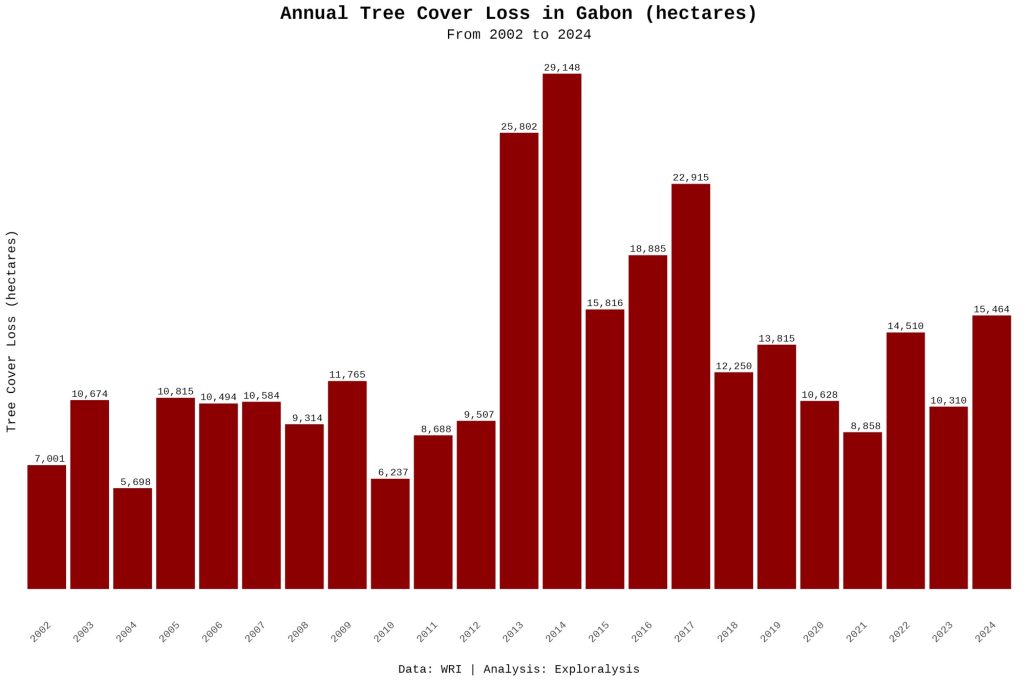
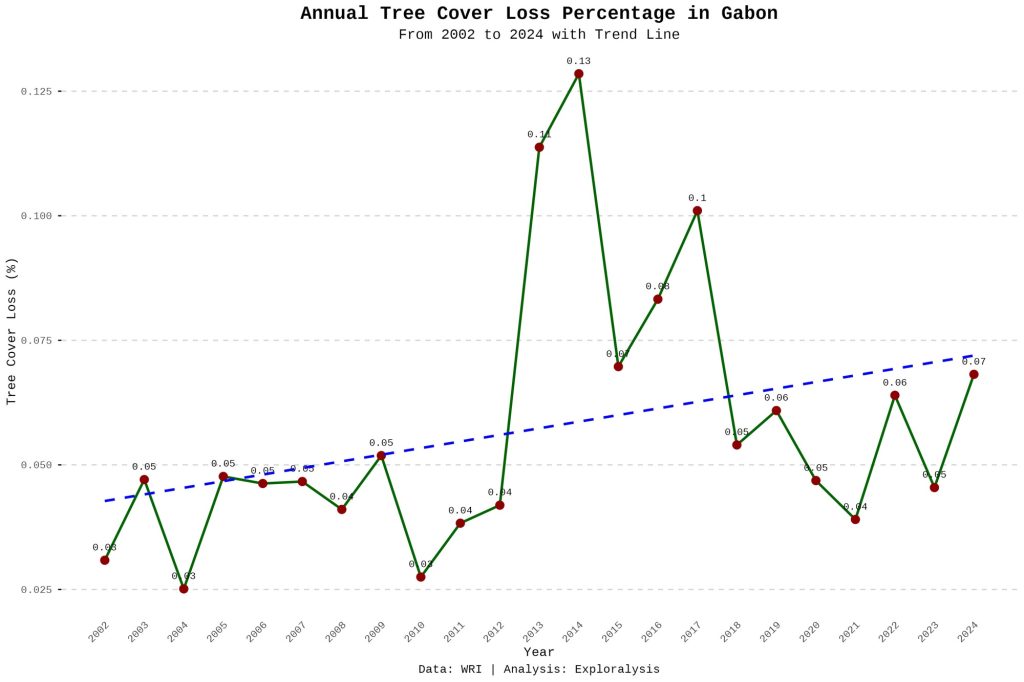
Gabon experiences slow growth until 2012, a steep increase between 2013 and 2017, and then a return to a slower pace similar to the early years.
Republic of the Congo

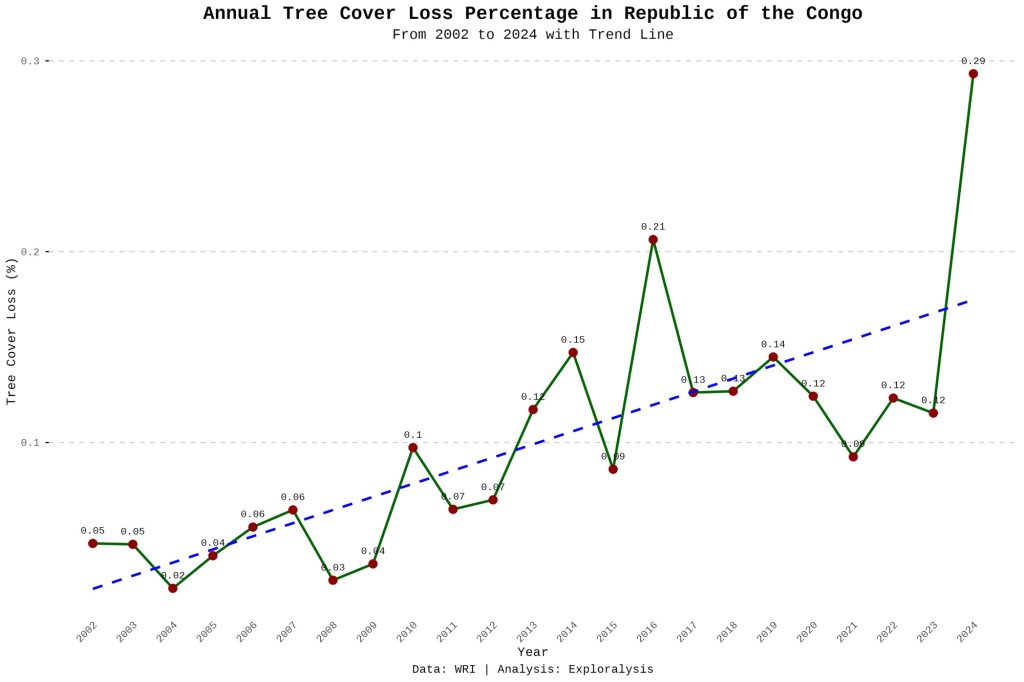
The Republic of the Congo follows a steady upward trend with prominent spikes in 2014, 2016, and 2024.
What These Patterns Tell Us
Six of the top ten countries show clear acceleration or spikes starting between 2013 and 2016. These countries span multiple regions, suggesting a global phenomenon rather than isolated national causes.
Nine of the top ten countries show an overall upward trend in deforestation, though the steepness varies. This indicates that rising deforestation has become the norm, but Indonesia’s reversal shows that change is possible under certain conditions.
Large forest countries account for the greatest absolute loss, while smaller forest countries suffer the greatest proportional loss. The latter often receive less international attention, even though the local ecological and social impacts can be severe.
Why This Matters
Humid tropical primary forests are irreplaceable on human time scales. Their loss affects climate stability, biodiversity, and the livelihoods of millions of people. Concentration of both forest area and deforestation in a small number of countries means targeted policies could have outsized global impact.
At the same time, countries with smaller forest areas but high percentage losses deserve far more attention. Losing a third of a country’s primary forest can permanently alter ecosystems and local economies, even if the global numbers appear small.
Data Source
All data used in this analysis comes from Global Forest Watch and the World Resources Institute.
( Nugroho Budianggoro )
Featured photo by Dylan Leagh