
In a world where international tensions can escalate quickly, understanding the military capabilities of nations is crucial. Nuclear forces often act as the ultimate deterrent in potential conflicts, making their monitoring essential for global stability. This article dives into the nuclear warhead stockpiles of key countries and explores global firepower rankings based on data from early 2026. We’ll draw from sources like the Federation of American Scientists for nuclear data and the Global Firepower website for overall military strength. The goal is to provide insights into the balance of power, helping us better grasp international relationships and conflicts.
The Role of Nuclear Warheads in Global Security
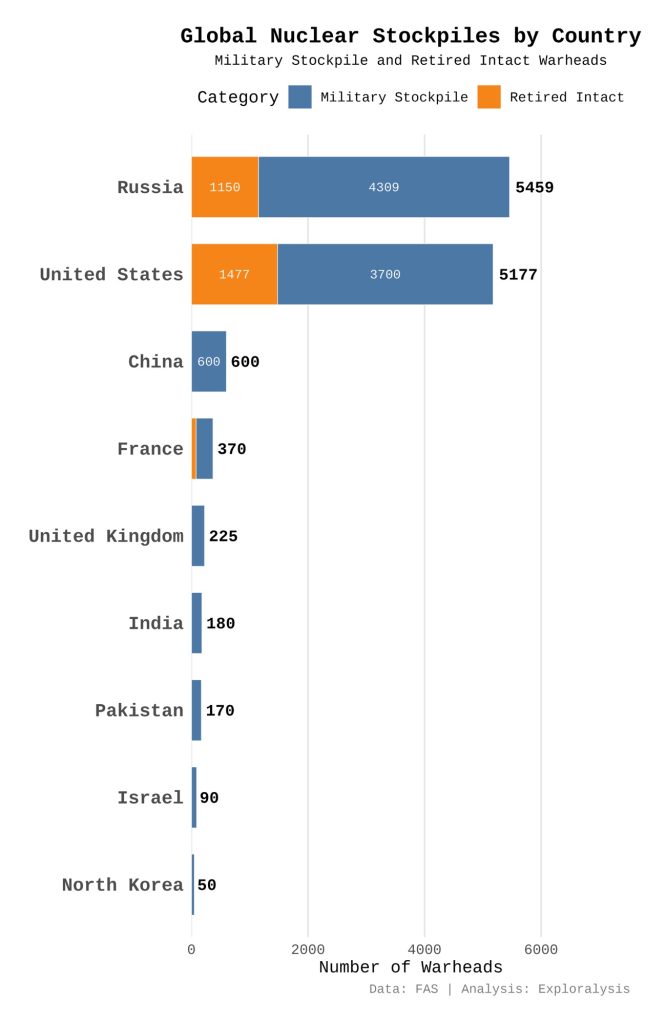
Nuclear weapons remain a deciding factor in any major war scenario. Their presence demands constant vigilance to prevent catastrophic outcomes. Currently, nine countries possess nuclear warheads: Russia, the United States, China, France, the United Kingdom, India, Pakistan, Israel (though undeclared), and North Korea.
Based on early 2026 data from the Federation of American Scientists, these stockpiles include active military warheads and retired ones awaiting dismantlement (still intact but not immediately deployable). Russia leads with 5,459 warheads, closely followed by the U.S. with 5,177. These two superpowers maintain near parity, likely as a strategic choice.
Other nations have far fewer: most hold under 400 warheads, or less than 10% of Russia or the U.S. totals. China stands out as an exception among the rest. Even a single warhead can cause immense destruction, as seen in 1945 with Hiroshima and Nagasaki. Those attacks killed at least 110,000 people immediately—mostly civilians—and another 100,000 by year’s end from injuries and radiation-related illnesses.
Warheads are retired due to aging parts, outdated technology, or treaty obligations. While they could potentially be reactivated, it would take months. Production limits come from factors like international treaties, resource constraints, technical hurdles, politics, and economics. Key treaties include the Treaty on the Non-Proliferation of Nuclear Weapons (NPT), the Comprehensive Nuclear-Test-Ban Treaty (CTBT), the Treaty on the Prohibition of Nuclear Weapons (TPNW), and New START.
Pros and Cons of Nuclear Arsenals
Having nuclear warheads offers several advantages:
• Deterrence against aggression from other nations.
• Prevention of major wars through mutual assured destruction.
• Enhanced geopolitical influence.
However, the downsides are significant:
• Potential for catastrophic humanitarian and environmental impacts.
• High maintenance and development costs.
• Risks of accidents or unauthorized use.
• Increased chances of proliferation to non-state actors.
Keeping nuclear forces in check through public discussion is vital to avoid repeating history’s tragedies.
Understanding Global Firepower Rankings
Shifting focus to conventional military strength, the Global Firepower (GFP) index provides a comprehensive view. Since 2006, GFP has ranked 145 modern militaries based on their potential in land, sea, and air warfare using conventional means. The ranking uses over 60 factors to calculate a Power Index score—lower scores indicate stronger capabilities.
Nuclear warheads are noted but not the primary factor. Importantly, the index isn’t linear; a score half as large doesn’t mean twice the strength. Key categories in the calculation include:
1. Manpower: Total population, available manpower, active military personnel, and reserves.
2. Air Power: Total aircraft, fighters, attack planes, transports, and helicopters.
3. Land Power: Tanks, armored vehicles, self-propelled artillery, towed artillery, and rocket systems.
4. Naval Power: Aircraft carriers, destroyers, frigates, corvettes, submarines, and patrol vessels.
5. Financial Strength: Defense budget, external debt, and purchasing power.
6. Logistics & Infrastructure: Airports, merchant marine, ports, roads, and rails.
7. Natural Resources: Oil production, consumption, and reserves.
8. Geography: Land area, coastline, borders, and waterways.
9. Special Modifiers: Domestic defense industry, geographic advantages/disadvantages, and access to oceans.
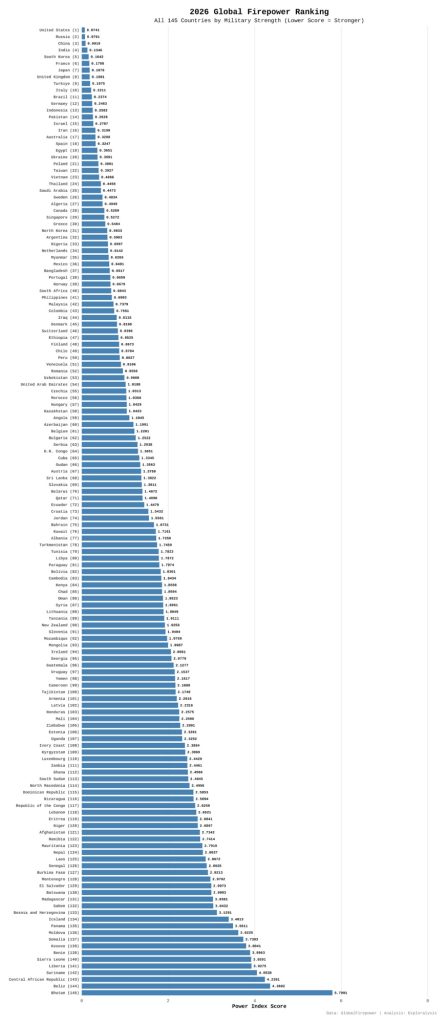
The overall rankings show a smooth progression, making it hard to group countries into clear tiers like “strong” or “weak.” The top 20 strongest nations in 2026 are: United States, Russia, China, India, South Korea, France, Japan, United Kingdom, Turkey, Italy, Brazil, Germany, Indonesia, Pakistan, Israel, Iran, Australia, Spain, Egypt, and Ukraine.
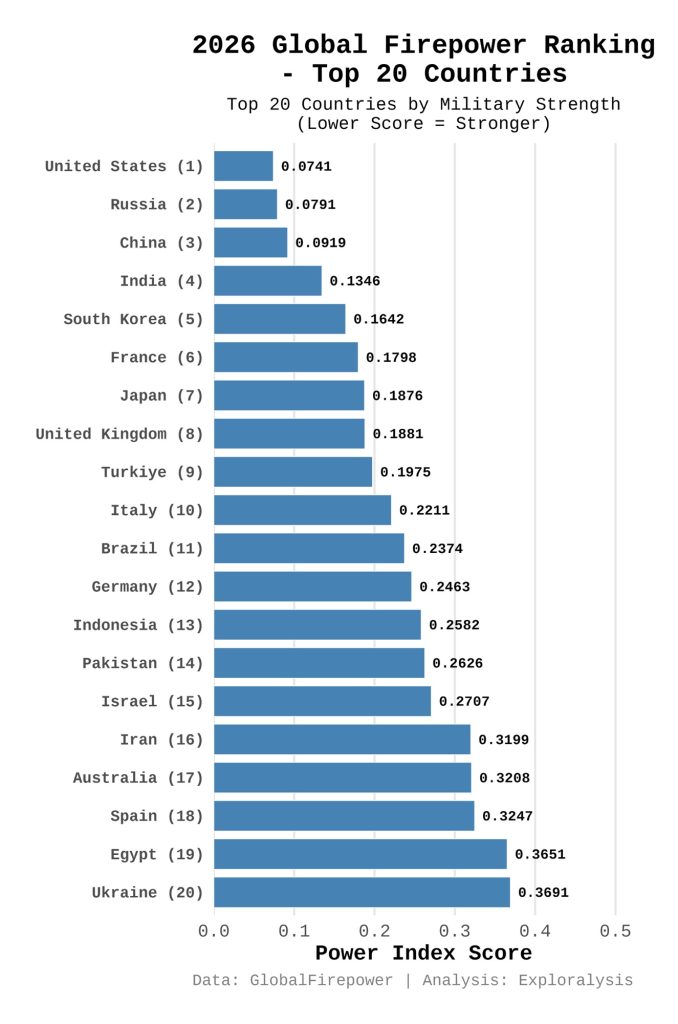
A key takeaway: Conflicts involving these top countries could have far more devastating effects than those with weaker militaries.
Firepower Breakdown by Subregion
To get a fuller picture, let’s examine firepower strengths within specific subregions. This reveals regional dynamics and how factors like population influence rankings.
West Africa
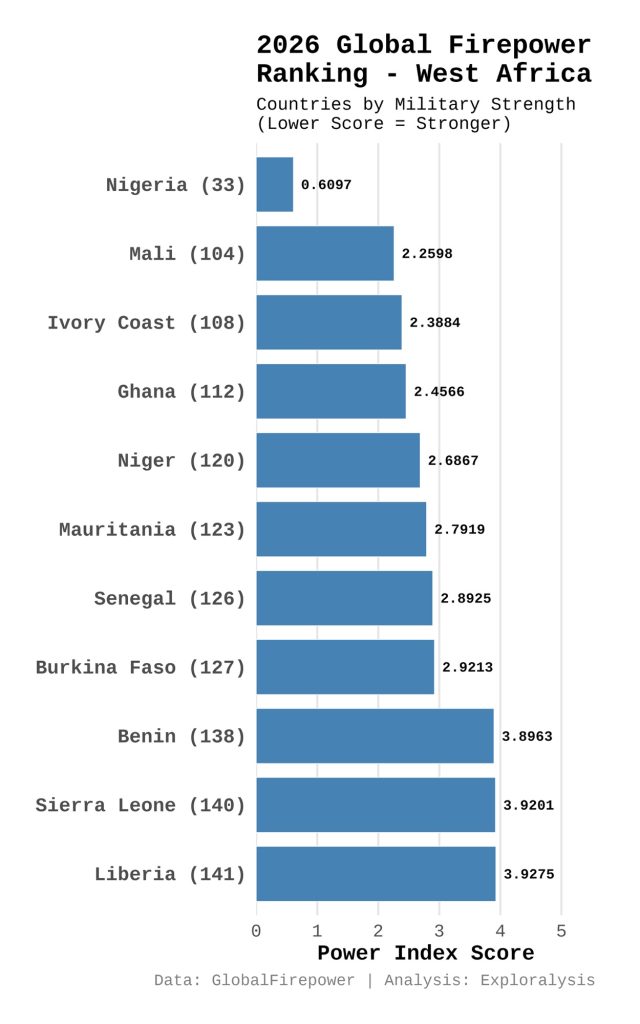
Nigeria stands out as the strongest, likely due to its large population—it’s the only West African nation in the global top 45 for population. Three groups emerge: Nigeria at the top; a middle cluster; and the weakest trio of Benin, Sierra Leone, and Liberia.
South Asia
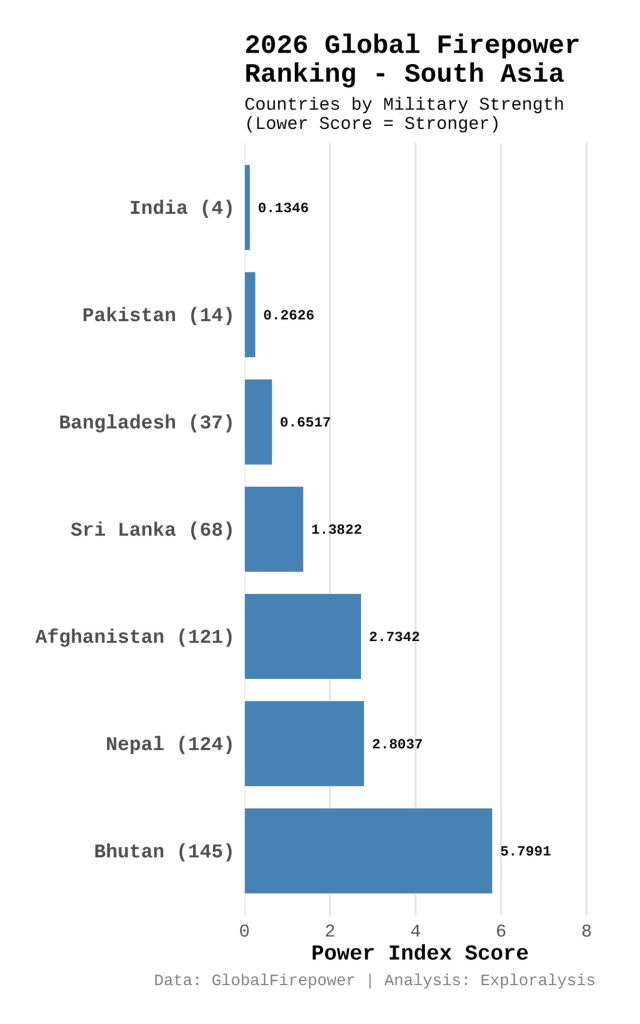
India leads, with Pakistan close behind and Bangladesh in third. These are also among the world’s most populous countries, highlighting population’s role. India and Pakistan’s nuclear arsenals add to their regional dominance. Bhutan is the clear weakest.
Oceania
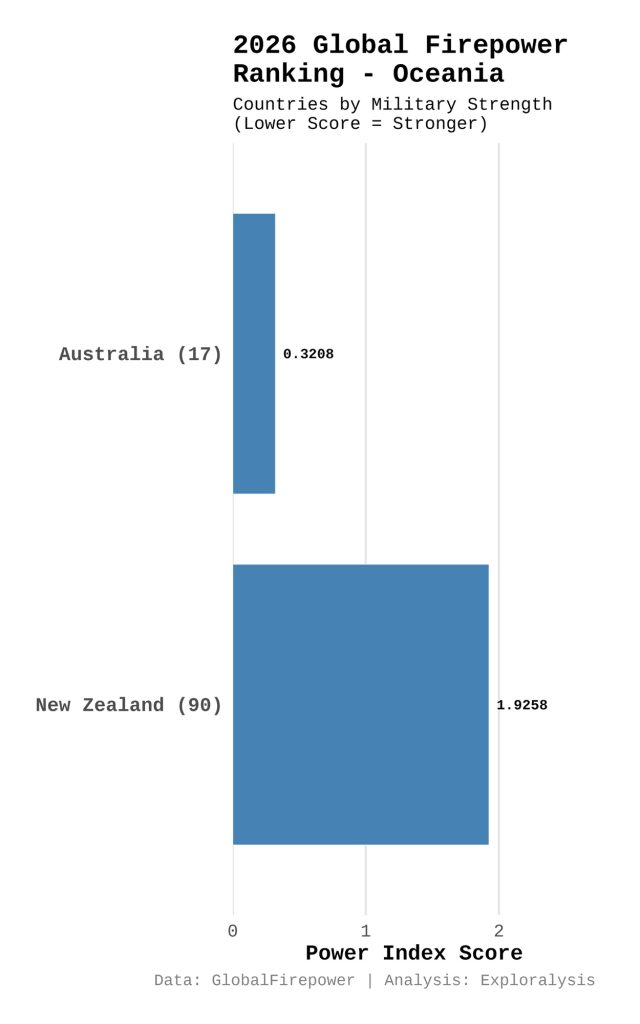
Only Australia and New Zealand are in the data, with Australia leading as expected.
Eastern Europe
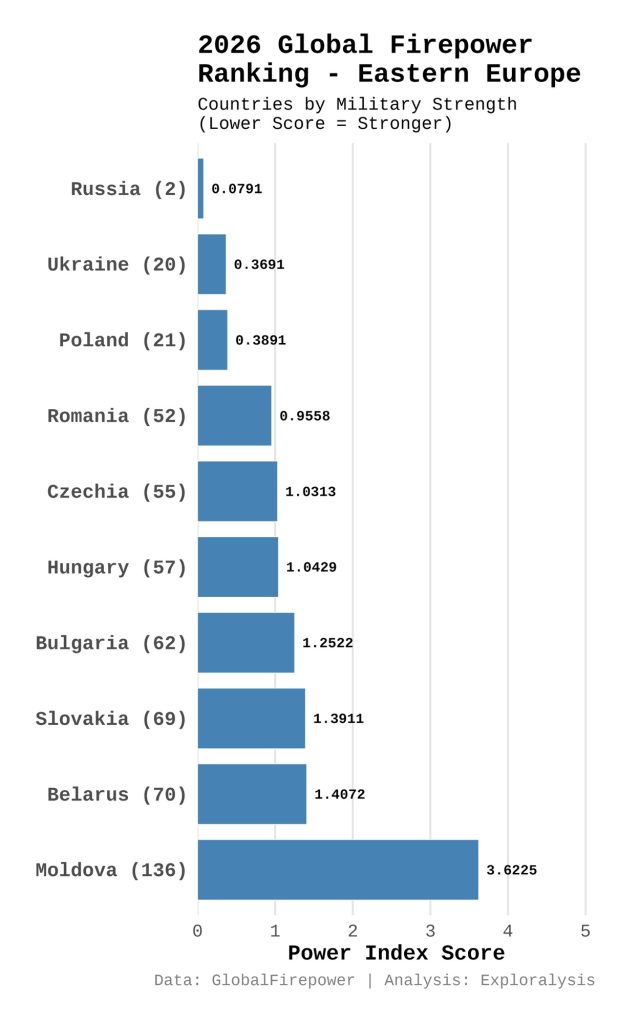
Russia dominates with a Power Index under 0.1. Ukraine and Poland follow (0.1-0.5), then Romania and others (0.5-1.5), with Moldova weakest at 3.6. Russia’s nuclear forces amplify its lead.
North America
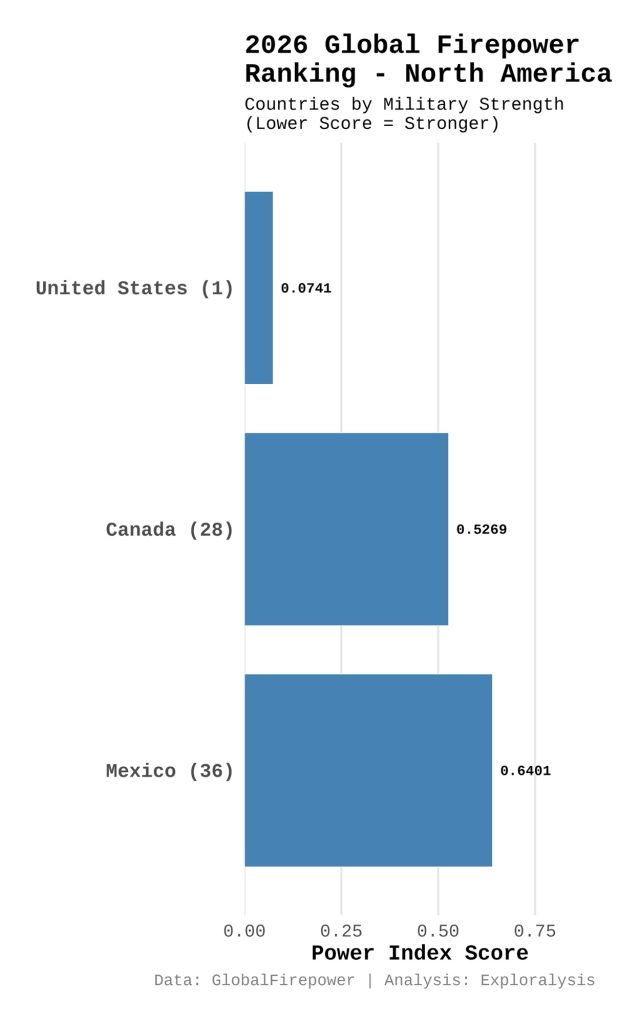
The U.S. is the global leader, far ahead of Canada and Mexico. Canada’s strength is closer to Mexico’s than to the U.S., despite the nuclear edge.
East Africa
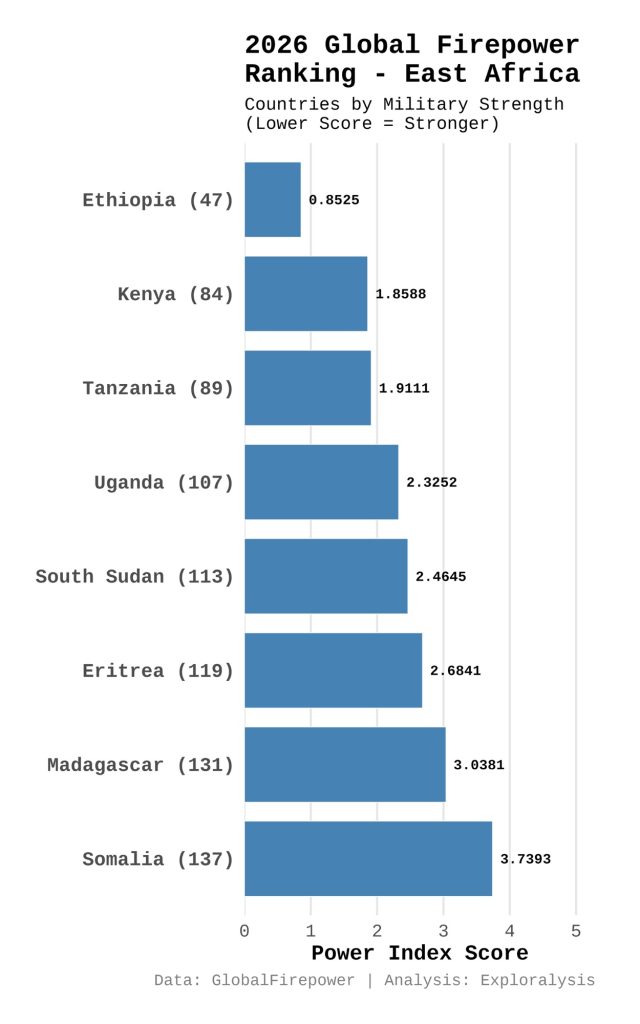
Ethiopia leads prominently, possibly due to its top-10 global population ranking—the only East African country there.
Southeast Asia
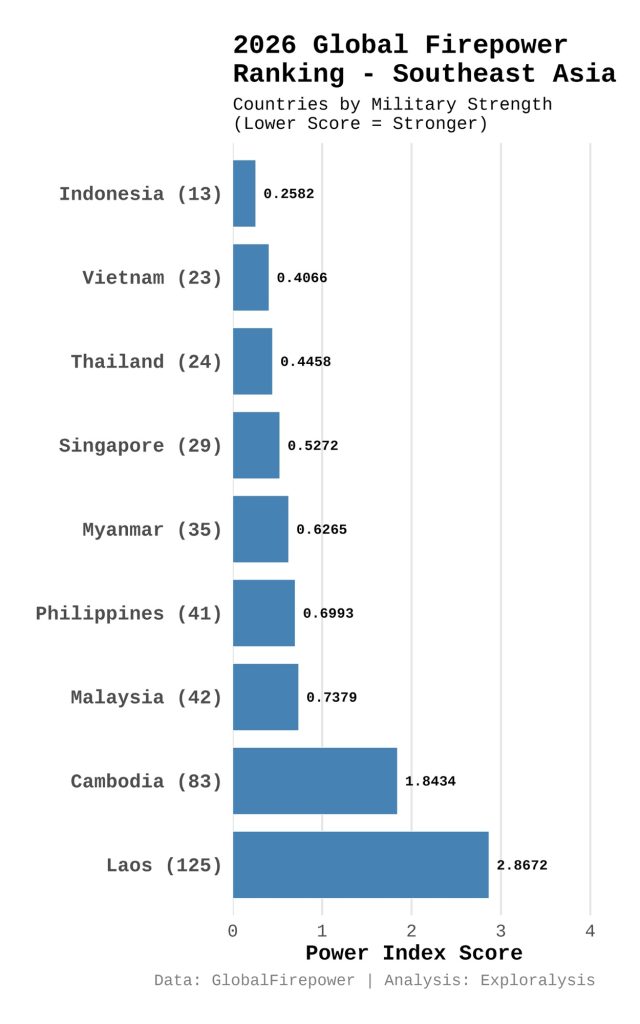
Indonesia tops the list but not by much over Vietnam and Thailand. Two groups: stronger nations under 1.0 (most), and weaker ones over 1.0 (Cambodia and Laos). As the fourth-most populous globally, Indonesia could potentially be even stronger relative to neighbors.
South America
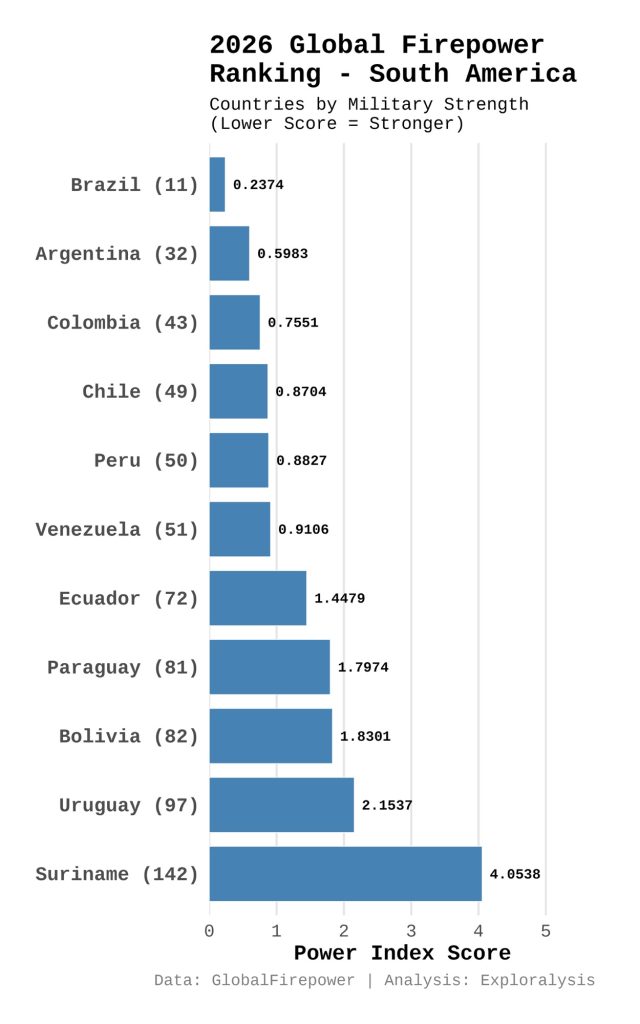
Brazil is the standout leader. Groups include stronger countries under 1.0 (Brazil, Argentina) and weaker ones over 1.0 (starting with Ecuador and Paraguay). Suriname is the weakest.
North Africa
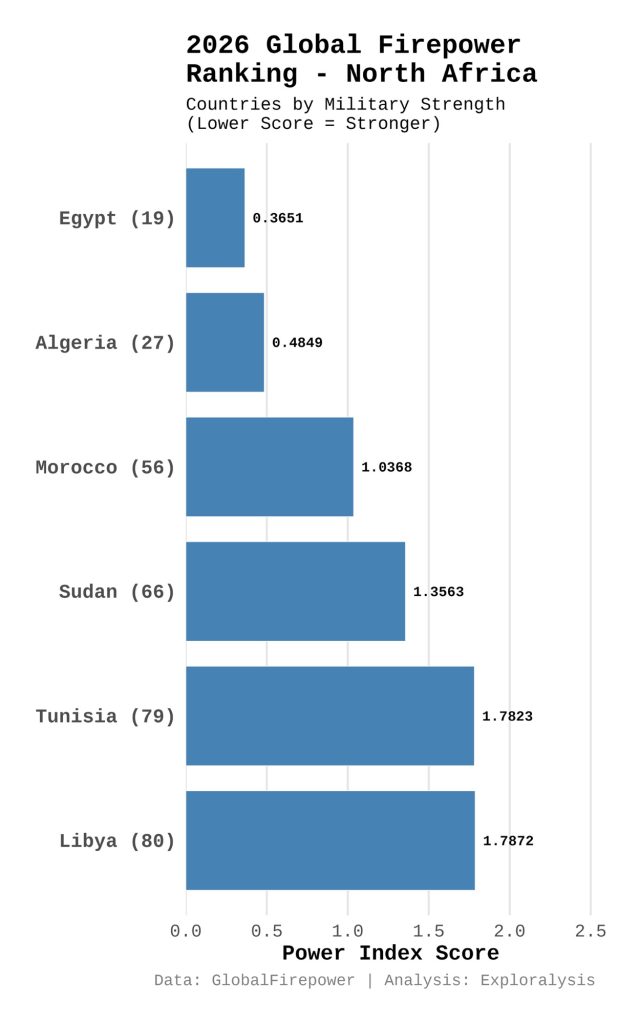
Egypt edges out Algeria, both under 1.0. The rest exceed 1.0.
East Asia
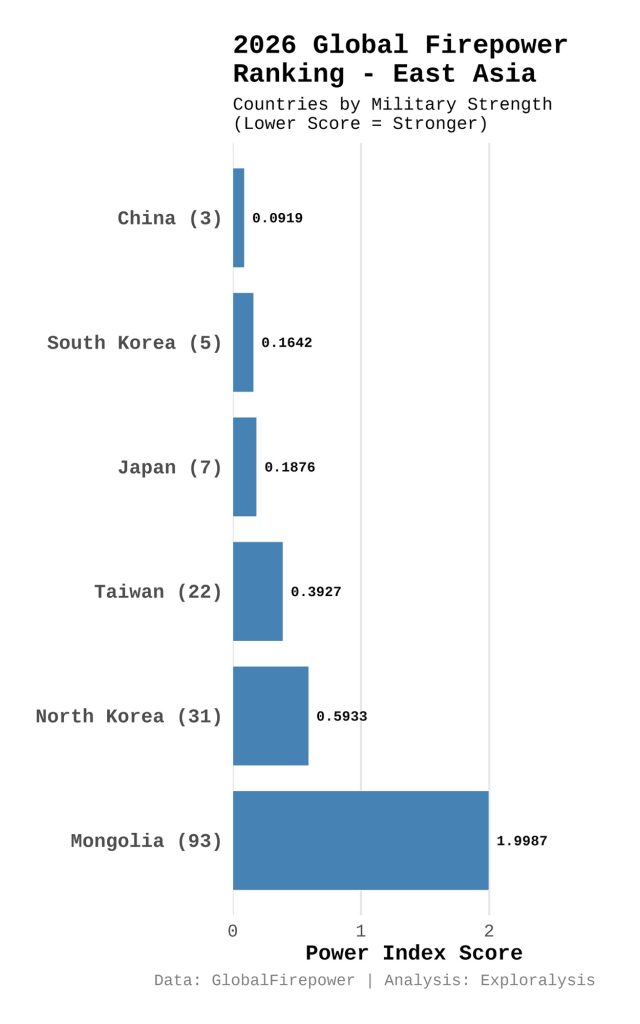
China leads decisively, followed by South Korea and Japan. China’s nukes boost its dominance. North Korea ranks lower despite its arsenal, with Mongolia weakest.
Central Asia
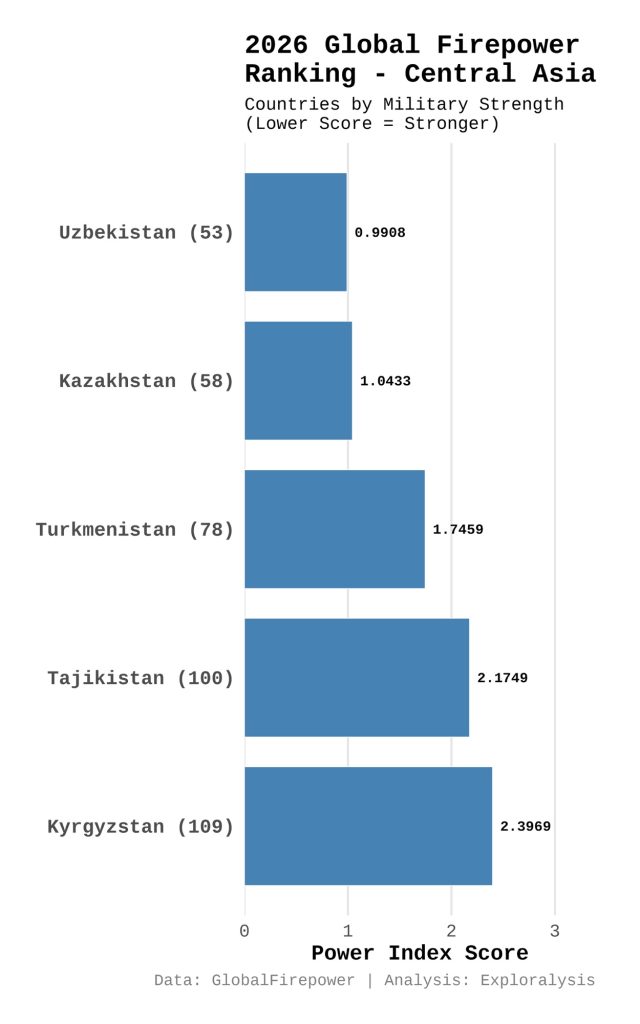
Uzbekistan leads slightly over Kazakhstan, with Turkmenistan, Tajikistan, and Kyrgyzstan trailing.
Western Europe
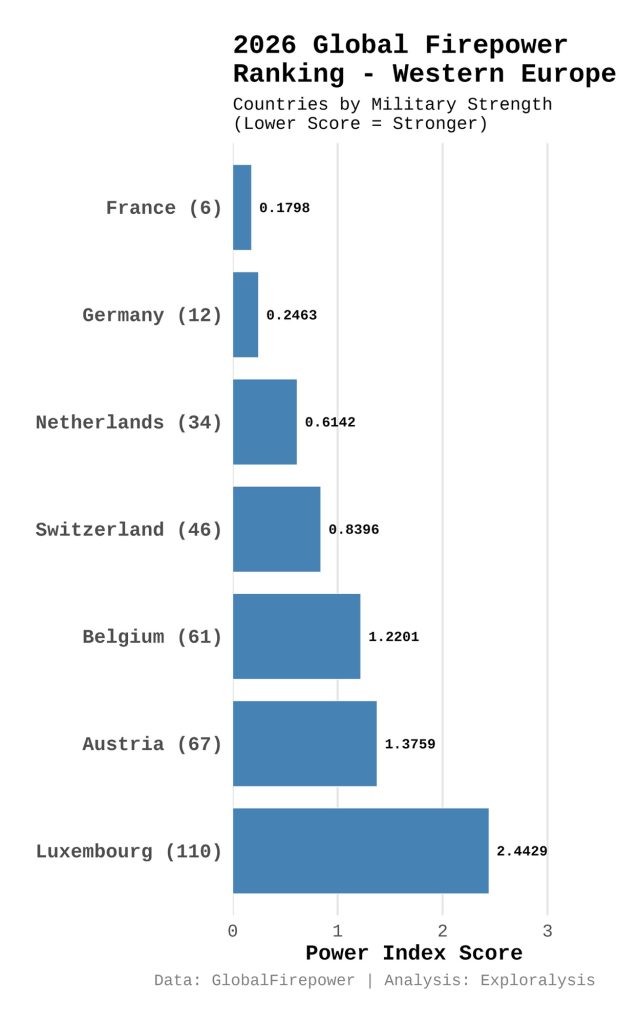
France tops Germany closely. Luxembourg is the weakest. France’s nuclear weapons enhance its position.
Southern Africa
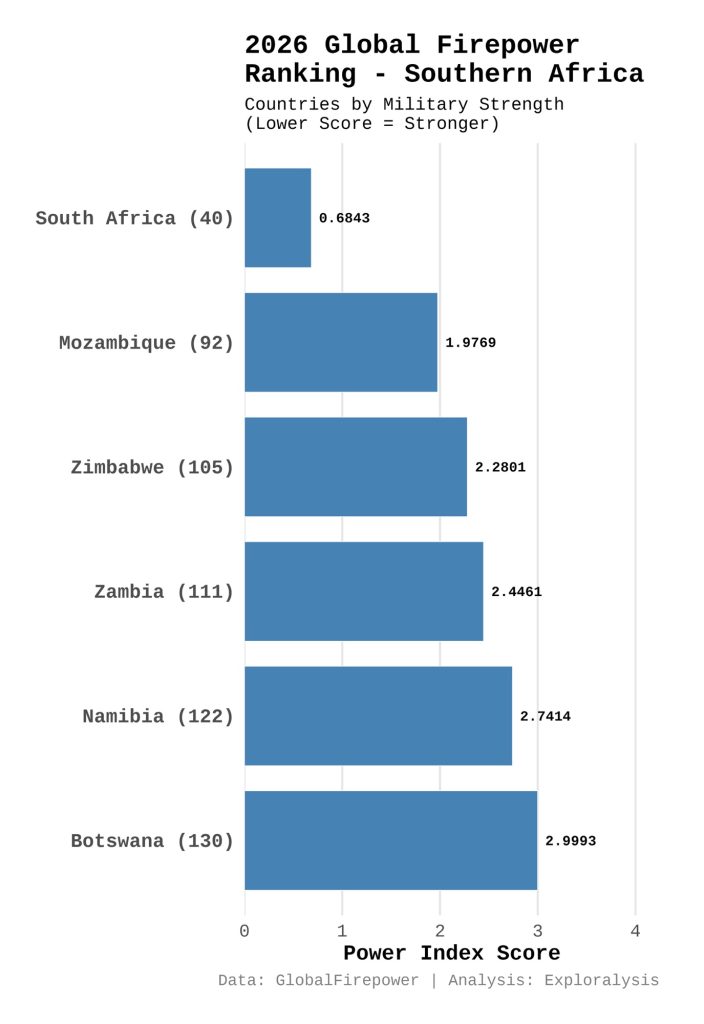
South Africa leads distinctly, with no clear groups among the rest.
Caribbean
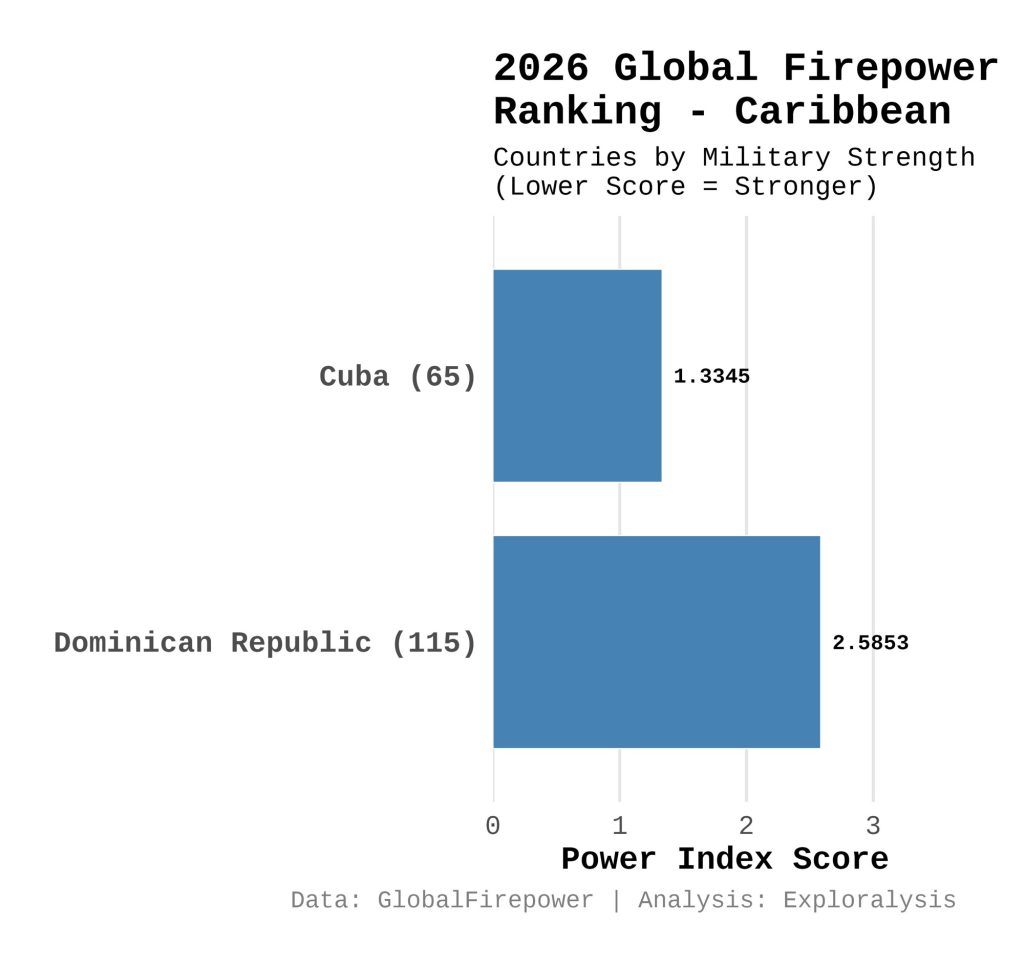
Cuba leads over the Dominican Republic in this limited dataset.
Northern Europe
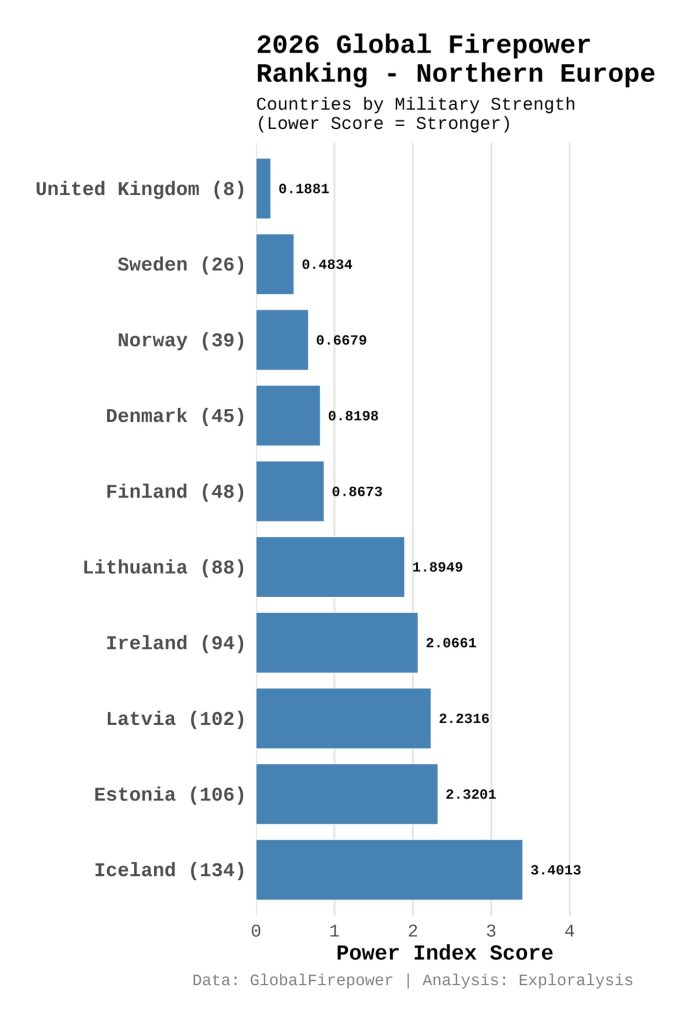
The U.K. leads with a score under 1.0, joined by Sweden, Norway, Denmark, and Finland. Others exceed 1.0. The U.K.’s nukes add weight.
Western Asia
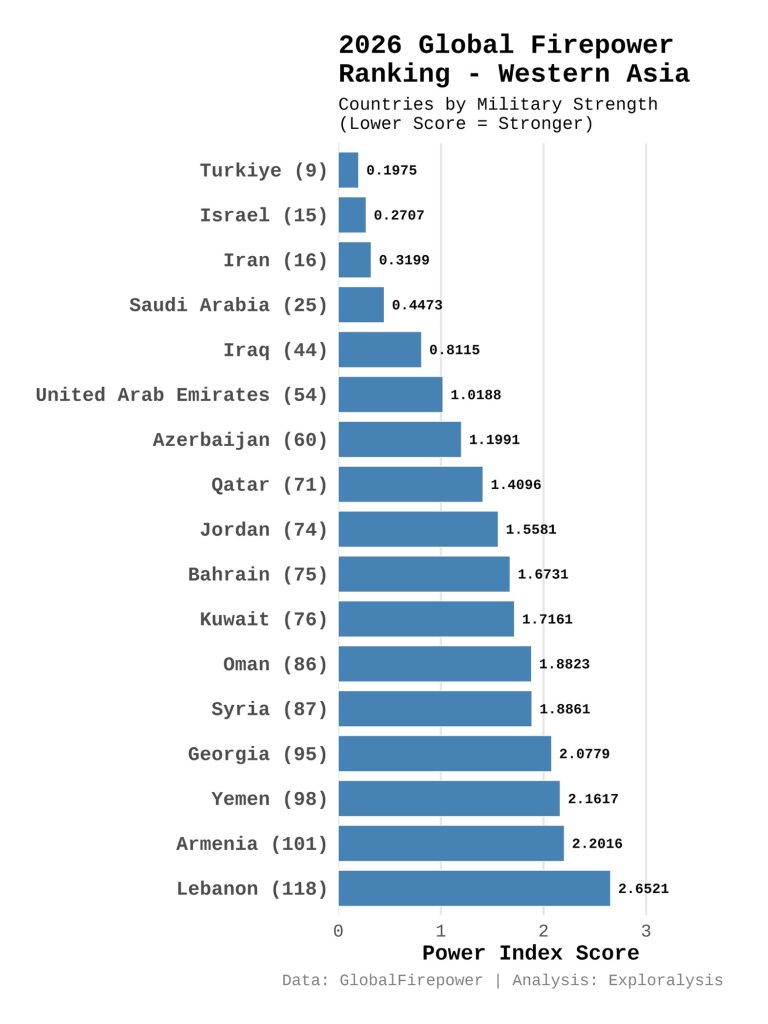
Turkey leads, with a top group under 0.5 (Turkey, Israel, Iran, Saudi Arabia) and the rest over 0.5. Israel’s undeclared nukes are a factor despite Turkey’s conventional edge.
Central America
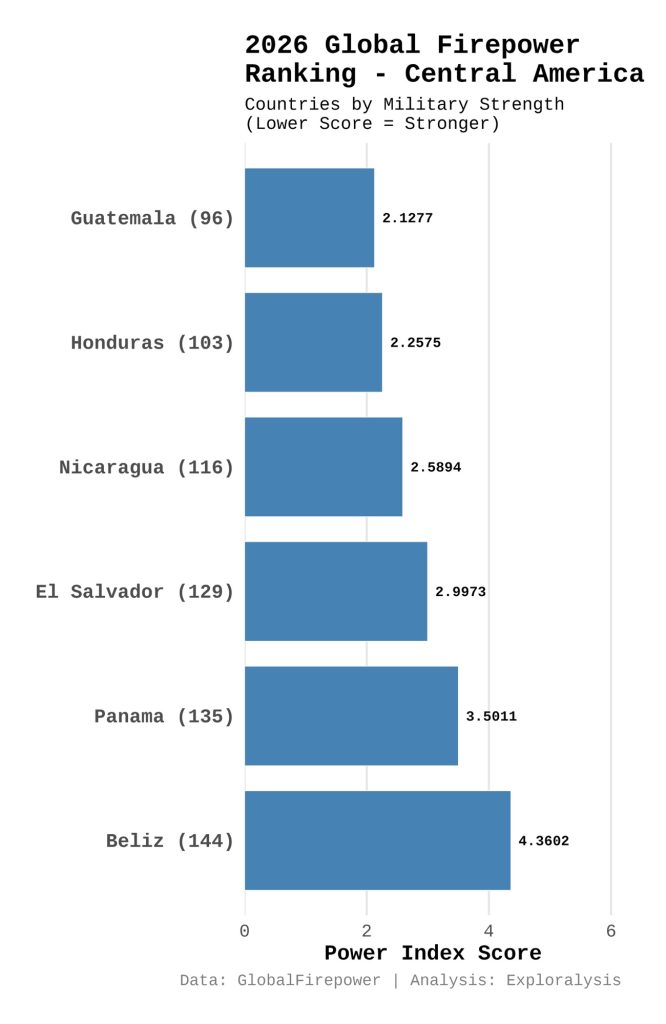
Guatemala leads Honduras closely, with no distinct groups.
Central Africa
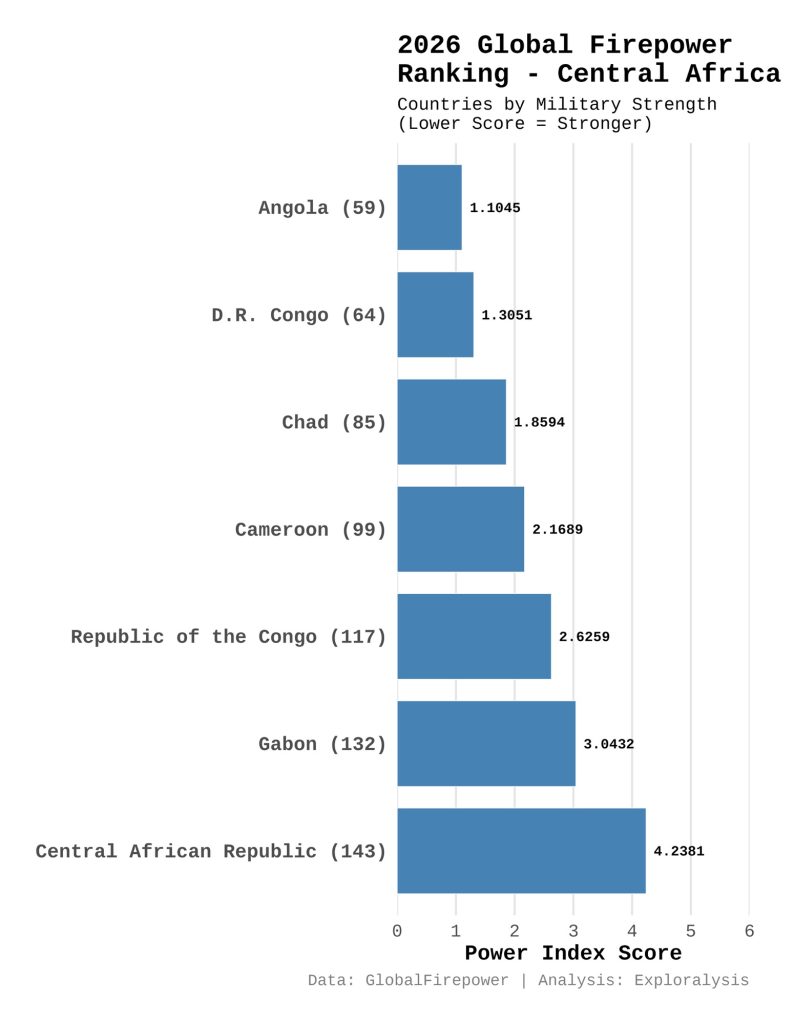
Angola tops D.R. Congo, again without clear groupings.
Southern Europe
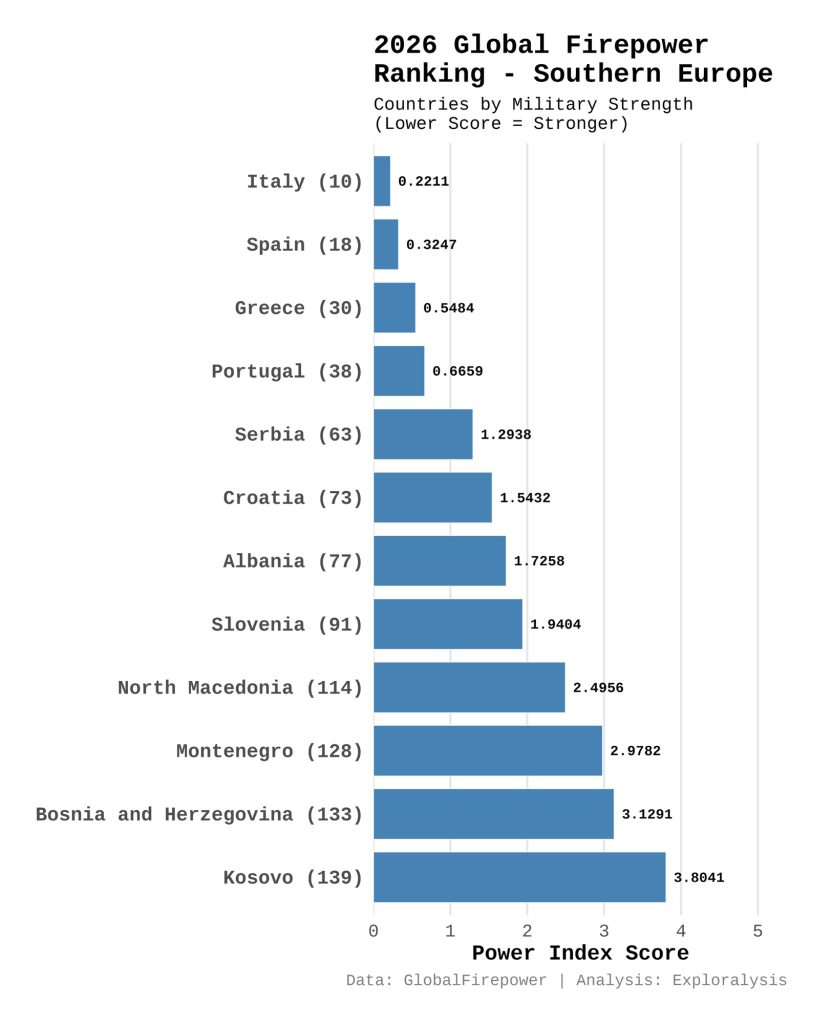
Italy leads Spain closely. The top four (Italy, Spain, Greece, Portugal) stand apart from the rest.
Why This Matters for Global Discussions
Insights into global and regional firepower, including nuclear capabilities, offer valuable perspectives on the balance of power. This knowledge can inform discussions about past, ongoing, or potential conflicts and foster better international relations. By staying informed, we contribute to efforts preventing escalation and promoting peace.
By: Nugroho Budianggoro
Cover photo by Juli Kosolapova